Last updated November 18, 2026
How to Hire an ADU Contractor in Las Vegas: A Step-by-Step Guide
Nevada’s contractor license database is public, free, and takes about 90 seconds to search. Most Las Vegas homeowners who hired a contractor that later walked off an ADU job never opened it. That’s the uncomfortable pattern we’ve watched repeat itself across the valley for years: the personality judgment comes first, the document check comes last, or never. This guide flips the order. You’ll learn exactly how to verify a Nevada license, which five documents to collect before you sign anything, what a lump-sum written price protects you from, and the Las Vegas-specific red flags that separate a real ADU builder from a remodeler who added the word to their website last year.
Quick Answer
To hire an ADU contractor in Las Vegas, verify their Nevada State Contractors Board license number and classification first, then collect five documents (license, insurance certificate, bond confirmation, permit history, and a written scope of work with a lump-sum price) before signing anything. Skip a contractor who can’t produce all five, regardless of how good they sound on the phone.
Table of Contents
- Step 1: Verify the Nevada Contractor License
- Step 2: Collect the Five Documents Before You Sign
- Step 3: Understand Why a Lump-Sum Written Price Protects You
- Step 4: Ask the Questions That Separate Real ADU Builders
- Las Vegas ADU Bid Red Flags
- Understanding Permits, Setbacks, and Clark County Rules
- Prefab vs. Conventional: Matching the Build Method to Your Lot
- What a Real Written Guarantee Should Say
Step 1: Verify the Nevada Contractor License
Every licensed contractor in Nevada carries a license number, and the Nevada State Contractors Board (NSCB) publishes it. You can search the license number or the business name at nscb.nv.gov in under two minutes. Do this before the first in-person meeting, not after. A contractor who isn’t licensed for ADU work is operating outside the law in Nevada, and if the job goes sideways you have no board complaint, no bond claim, and no recourse.
Here’s what to look for on the record:
- Active status. The license should read “active,” not “expired,” “suspended,” or “voluntary surrender.” A license that lapsed three months ago can’t legally pull a permit today.
- The right classification. ADU work is residential construction, so you want a Class B (general building) license at minimum, or a Class A if the project scope includes any commercial-grade structural. A Class C specialty license (framing, electrical, plumbing) is not enough to act as the prime contractor on a full ADU build.
- The contracting business name matches. The name on the bid should match the name on the license. If the bid says “Neighborhood Builds” but the license belongs to “NV Dream Homes LLC,” ask how they’re related in writing.
- No disciplinary history. The NSCB posts disciplinary actions publicly. A single past complaint isn’t automatically a dealbreaker, but a pattern of unlicensed contracting or abandoned jobs is.
If you’re also weighing a garage conversion versus a backyard unit, our Garage Conversion Contractor in Las Vegas page walks through the permit path for conversions specifically, which follows a different track than a standalone ADU.
Step 2: Collect the Five Documents Before You Sign
A verbal “yeah, we’re fully insured and bonded” isn’t a document. Before a single nail goes in, a real ADU contractor hands you five things, and a Las Vegas homeowner should treat the absence of any one of them as a stop sign.
- Current license certificate. A PDF copy of the active NSCB license, with the classification visible.
- Certificate of insurance. General liability coverage for a Las Vegas ADU project should be at least $1 million per occurrence. Call the insurance company listed on the certificate (they’re on the page) and confirm the policy is still in force, because certificates from expired policies circulate.
- Bond confirmation. Nevada requires licensed contractors to carry a surety bond. Ask for the bond number and the surety company. A bond is what gives you a legal claim if the contractor takes your deposit and doesn’t show up.
- Permit history. Ask for the address and permit number of two recent ADU or addition projects they pulled permits on. You can look up the permit status in the Clark County or City of Las Vegas online portal yourself. This one step filters out a surprising number of “ADU contractors” who’ve never pulled an ADU permit.
- Written scope of work. Room-by-room, trade-by-trade, with the total lump-sum price at the bottom, signed and dated. No asterisks, no “plus materials,” no “TBD.”
If a contractor stalls on any of the five, that’s your answer. Move on.
Step 3: Understand Why a Lump-Sum Written Price Protects You
Time-and-materials contracts (T&M) are the reason so many Las Vegas homeowners end up angry. Under T&M, the contractor bills for hours worked plus materials, and the “estimate” you got on day one isn’t binding. The number drifts up the moment the schedule slips, and the risk of delay sits entirely on you, the homeowner, not the builder who set the schedule.
A lump-sum written price flips that. The contractor absorbs the risk of estimating wrong. You approve one number before the first nail goes in, and that number is the one on the final invoice. Here’s the language to insist on in the contract:
- “This is a fixed-price contract. The total price below is the total you will pay, subject only to written change orders you sign.” If the contractor won’t sign that sentence, walk.
- A written change-order process. Any addition or change must be in writing, priced, and signed by you before the work happens. No verbal “we had to add $4,000 for framing” after the fact.
- A payment schedule tied to milestones. Nevada law limits how much a contractor can ask for upfront on residential work. A reasonable schedule pays out at foundation, framing, rough-in, drywall, and final inspection. Never pay the full amount before the final walk-through.
- A written list of what’s excluded. Landscaping? Solar? Fencing? Get it in writing so the exclusions don’t become surprises.
For a plain-dollar anchor, garage conversions in Las Vegas typically run $45,000 – $85,000 before permit fees, and standalone backyard ADUs run $120,000 – $280,000 depending on square footage, build method, and utility runs. Those ranges exist so you can self-qualify against a bid before you call. A bid $40,000 under the low end of the range on a suburban Las Vegas lot is not a deal – it’s a warning.
Step 4: Ask the Questions That Separate Real ADU Builders
There are general remodelers in Las Vegas who can build a great kitchen and have never navigated an ADU permit. Then there are builders who do this every week. The difference shows up in the first ten minutes of the interview if you know what to ask.
- “How many ADU permits have you pulled in Clark County in the last 12 months?” Not “how many ADUs have you built.” The permit number is public and verifiable. A real ADU builder will give you addresses.
- “What’s the setback requirement on my lot, and have you built an ADU within it before?” The answer should mention a setback variance (the city’s written permission to build closer to the property line than the standard rule allows) if your lot is tight. A blank stare means they’ve never dealt with one.
- “Who pulls the permit?” If the answer is “you do” or “the owner will handle it,” walk. A licensed contractor pulls their own permits.
- “Who’s on the crew?” Direct employees, or rotating subcontractors with no named accountability? You want to know the name of the person accountable when something goes wrong, and you want it in writing.
- “Are your crews background-checked and uniformed?” A crew entering your backyard for eight weeks is in your life. Verified, uniformed technicians are the baseline for a professional operation.
- “What’s your written guarantee, and how long does it run?” A real guarantee is on paper, names what it covers, how long it lasts, and how the contractor makes it right.
Our ADU Builders in Las Vegas page covers the build process end to end, and if you’re weighing an attached addition instead, see the Room Addition Contractor in Las Vegas page for the differences in scope and permitting.
Las Vegas ADU Bid Red Flags
Bids that look great on paper are often the ones that end badly. These are the specific patterns worth flagging on any Las Vegas ADU proposal:
- Prices far below market. A $78,000 bid for a 600-square-foot detached ADU in Las Vegas isn’t thrifty – the number is missing something, usually the permit pull, the utility trench, or the foundation. The missed costs reappear as change orders mid-build.
- Verbal permit promises. “Oh yeah, we’ll get the permit, no problem” said aloud but not written into the contract is the single most common reason Las Vegas ADU projects stall. Get the permit pull in writing, on the contractor.
- Subcontractor-only crews with no named lead. When the general contractor isn’t the person accountable on site, and the electrician, framer, and drywaller each blame each other, you’re the one left explaining the delay to your family.
- A high-pressure deposit request. Nevada residential law limits deposit size. A contractor asking for 50% upfront before a single permit is filed is a red flag, not a discount.
- No ADU permit history on file. If they can’t name a single ADU permit number they’ve pulled in the county, they’ve never done this before, no matter what the website says.
- References you can’t verify. Ask for two recent Las Vegas clients whose ADU they can name by street. Drive by the address. If it doesn’t exist, neither should your signature.
Understanding Permits, Setbacks, and Clark County Rules
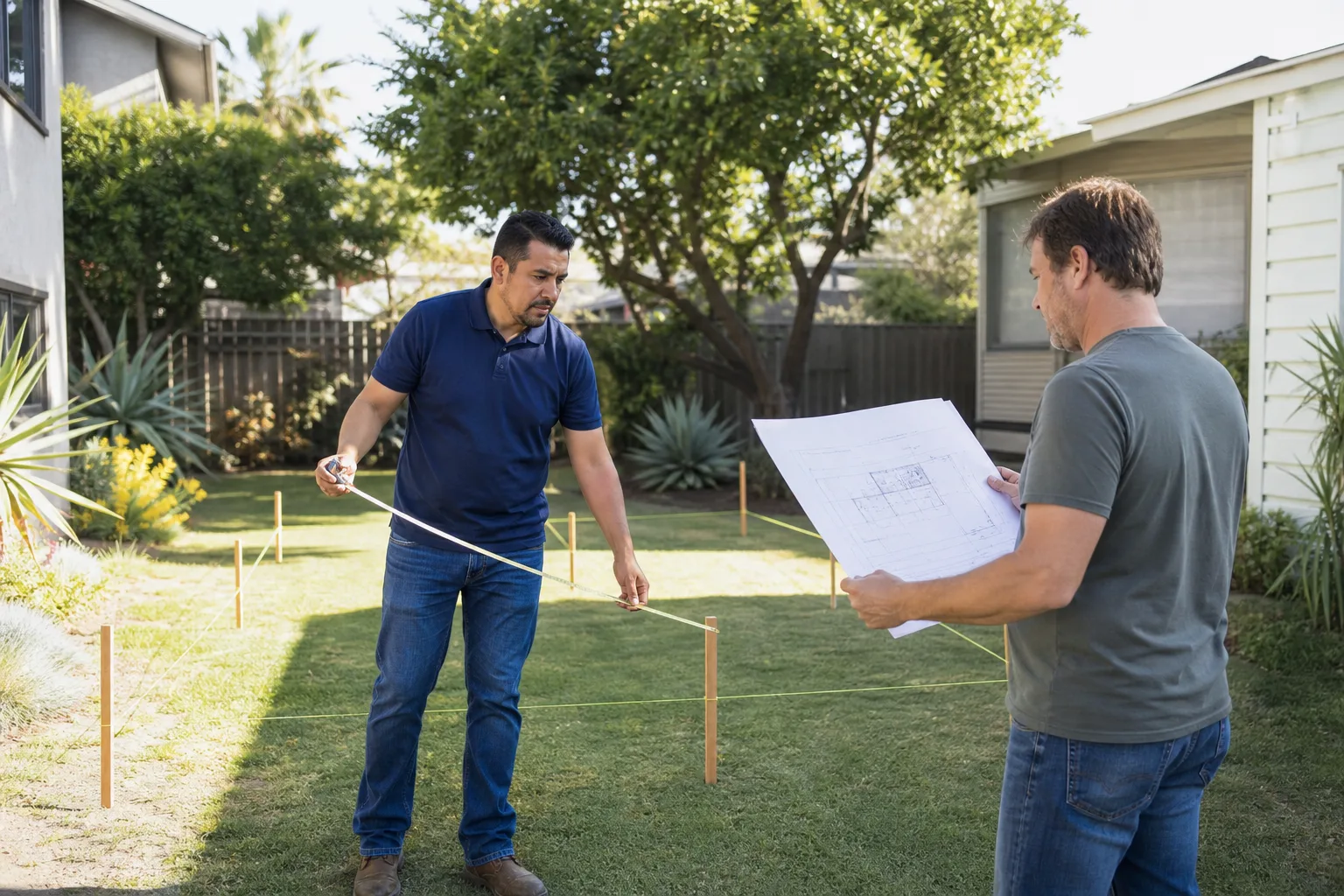
ADU permits in the Las Vegas valley run through either Clark County or the City of Las Vegas depending on the parcel, and the review timeline typically runs 6 – 10 weeks for a detached unit. The permit review covers zoning (allowed on the lot?), setbacks (how close to the property line?), height limits, and utility connections. A permit that’s filed but not yet approved is not a green light to start work, and a contractor who wants to break ground before the permit is issued is begging you to fund a demolition you might be ordered to undo.
Southern Nevada’s climate shapes the build in ways homeowners from other states don’t anticipate. The summer heat means an ADU needs a properly sized HVAC system and insulation spec, or your energy bill in July will remind you every month. Slab foundations are typical (basements are rare here), which affects plumbing rough-in. Dust and wind on the east side of the valley (Henderson, North Las Vegas) can shorten the exterior finish lifespan if the wrong siding is used, which is one reason we favor James Hardie fiber cement for its heat and moisture performance in this market.
Every permit we pull is inspected by the county or city as part of the project close-out, and we don’t consider a job finished until the inspection passes. If the permit path and inspection schedule for your lot are unclear, our Fielding ADU Builders Las Vegas home page lists what we cover.
Prefab vs. Conventional: Matching the Build Method to Your Lot
Not every Las Vegas lot suits a conventional stick-built ADU, and not every budget suits a prefab. Here’s the plain comparison: a conventional ADU gives you the most flexibility on layout and finish, and the permit path is well-established in Clark County. A prefab or modular ADU arrives faster, is engineered to exact specs, and can be installed on a tight lot, but the utility tie-in and foundation work are still site-built, so the schedule saving is real but partial.
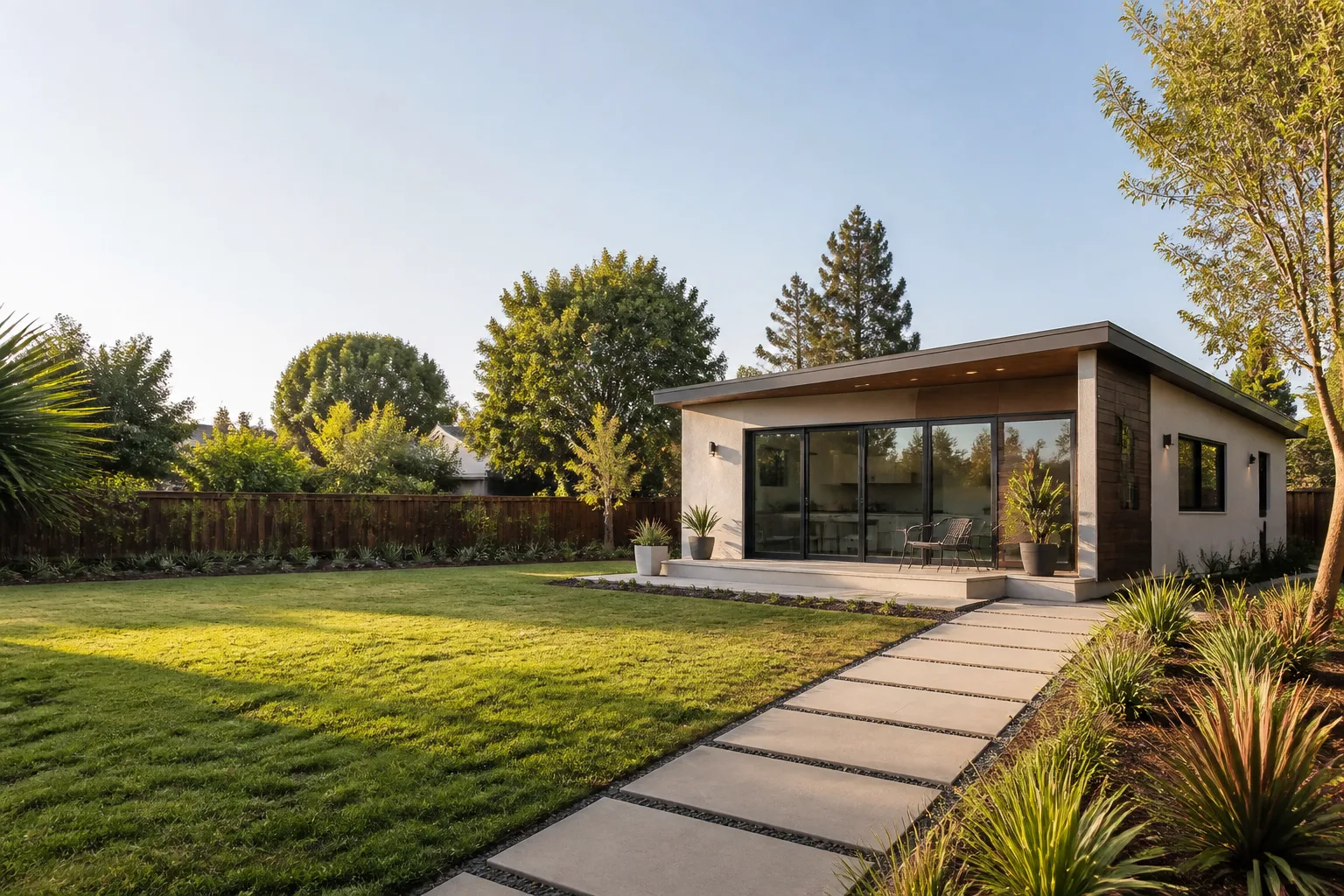
We match the build method to your lot, not the other way around. We work with the major prefab and modular platforms (Abodu, Cover, Dvele, Mighty Buildings, Boxabl, and Plant Prefab), plus conventional builds using James Hardie siding and Tuff Shed-style structures where a smaller detached studio makes sense. The right answer depends on your setback, your utility runs, your budget, and how fast you need the unit finished – and we’ll show you all three options with the price on each before you choose.
What a Real Written Guarantee Should Say
A one-year workmanship guarantee isn’t a slogan – it’s a contract clause. It should name what’s covered (defects in workmanship and materials), how long it runs (365 days from completion), and exactly what the contractor does if something fails. The Garrison Standard we hold ourselves to spells all three in writing on every project: if the work fails within 365 days, we return at no charge and correct the defect. No reminder calls, no “scheduling queue,” no arguments about whether the problem is ours.
Ask any ADU contractor for the guarantee in writing before signing. The phrasing to look for: a named coverage period, a named list of covered defects, and a named remedy. If the answer is “our work speaks for itself,” it doesn’t – a signature line does.
Common Mistakes to Avoid
- Checking the license after the deposit. Searchable in 90 seconds, and yet most homeowners who got burned never did it. Do it first.
- Hiring a general remodeler for an ADU. A kitchen builder can build a great kitchen and still have zero ADU permits in the county. Ask for the permit numbers, not the philosophy.
- Accepting a T&M contract on a fixed-scope project. Time-and-materials shifts schedule risk to you and gives the contractor no incentive to finish on time.
- Letting the permit slide. Some Las Vegas ADU projects start before the permit is issued “to save time.” Those are the ones that get red-tagged, demoed, and restarted.
- Paying 50% upfront. Nevada law caps residential deposit amounts, and a contractor who asks for half before the permit is filed is a warning sign.
- Failing to verify the insurance certificate is still in force. A certificate from an expired policy looks identical to a current one. Call the insurer.
- Skipping the reference drive-by. Looking at the street address of a recent ADU is the fastest way to see whether the photos match the work.
When to Call a Professional
If you’re considering a detached ADU, a garage conversion, or a room addition on your Las Vegas property, and you’re not certain about the setback, the permit path, or the honest price range on your lot, call a licensed local ADU builder before you start collecting bids. The estimation and permit steps are where most projects go sideways, and doing them once with a professional beats doing them twice with a contractor who’s learning on your property. Our technicians have up to 20 years of experience, and the ADU build consultation is free. If you’d rather buy a prefab, an experienced builder can still lay out the site work, utility tie-in, and permit path so the modular delivery doesn’t stall on a utility trench. Fielding ADU Builders Las Vegas offers free estimates in Las Vegas, and a live person answers the phone around the clock. Call (888) 418-2161 to schedule yours.
Frequently Asked Questions
An ADU build in Las Vegas typically runs $120,000 – $280,000 for a standalone backyard unit, and a garage conversion runs $45,000 – $85,000 before permit fees. The range depends on square footage, whether the build is prefab or conventional, and how far the utility runs have to travel on the lot. Call (888) 418-2161 for an exact quote – the estimate is free and the price comes to you in writing.
Search the contractor’s license number or business name at nscb.nv.gov, the Nevada State Contractors Board public database, and confirm three things: the license is active, the contracting business name matches the bid, and the classification (Class B or higher for ADU work) covers the scope. The search takes under two minutes, and it’s the first step, not the last.
Yes. Every ADU in Las Vegas, whether it’s a detached unit, a garage conversion, or a room addition, requires a building permit through either Clark County or the City of Las Vegas depending on the parcel. Permit review for a detached unit typically runs 6 – 10 weeks. Work started before the permit is issued can be red-tagged and ordered to be demolished, which is why the permit pull belongs on the contractor’s side of the contract in writing.
Not on a fixed-price contract with written change orders. We price every project in writing before the first nail goes in, and that number is the one on the final invoice. If something in the scope genuinely has to change, you get a written change order to sign before any of it happens. Call (888) 418-2161 for the specific estimate on your lot.
A conventional detached ADU in Las Vegas typically takes 4 – 6 months from permit approval to final inspection, and a garage conversion typically takes 2 – 3 months. Prefab and modular units can shorten the on-site build phase, but utility tie-in and foundation work are still done on site, so the total timeline is usually comparable. The permit review itself (6 – 10 weeks) sits in front of that timeline either way.
The contractor pulls the permits. That’s the standard on every ADU we build in Las Vegas, and it’s the only arrangement that keeps accountability in one place. If a bid leaves the permit pull to you, you’re funding a build with no licensed party on record for the work, and the permit history you’d use to verify a future contractor won’t exist. Call (888) 418-2161 to talk through the permit path on your lot.
The Bottom Line
Hiring an ADU contractor in Las Vegas is a document check first and a personality judgment second. Verify the Nevada license in the public database. Collect all five documents (license, insurance certificate, bond confirmation, permit history, written scope of work). Insist on a lump-sum price with a written change-order process. Ask for the actual ADU permit numbers in Clark County and look them up yourself. If the bid feels too low or the permit promise is verbal, walk away – the next contractor is better than the one who leaves the job half-finished. The right builder shows up in the window, prices the work in writing, pulls the permit by the book, leaves the site clean, and stands behind the work for a year. Call (888) 418-2161 for a free estimate on your Las Vegas ADU and get the price in writing before anything else happens.
Written by the team at Fielding ADU Builders Las Vegas.