Last updated November 18, 2026
Room Addition Contractor Maintenance Checklist for Las Vegas Homeowners
The most expensive room addition repairs in Las Vegas trace back to the first summer after construction. Not because the build was wrong, but because nobody checked whether the new roof tie-in could handle a 60-degree thermal swing or whether the added square footage quietly overtaxed the existing AC unit. We’ve walked through additions in Summerlin and Green Valley where a year of unchecked expansion turned a hairline stucco seam into a $9,000 water intrusion repair. This guide gives you the inspection calendar nobody handed you at closeout: what to check, when to check it, and the exact failure points that matter in Las Vegas.
Quick Answer
After a room addition in Las Vegas, inspect the roofline transition and all new stucco seams at the one-month, six-month, and twelve-month marks, and verify your HVAC system’s tonnage against the new square footage before the first summer. Most post-construction failures show up between June and September, when thermal expansion stresses every tie-in on the build. A proper 12-month checklist covers roof transition, stucco cracks, HVAC load, drainage, and door/window seals in that order.
Table of Contents
- The Roofline Transition: Your Highest-Risk Point
- Stucco Crack Inspection in the Las Vegas Climate
- HVAC Capacity Checks After a Room Addition
- Your 12-Month Las Vegas Inspection Calendar
- Drainage, Grading, and Monsoon Season
- What a One-Year Written Guarantee Should Cover
- What to Do If Your Contractor Goes Silent
- Common Mistakes to Avoid
The Roofline Transition: Your Highest-Risk Point
Where the new roof meets the old roof is the single point most likely to fail on a Las Vegas addition. The reason is thermal expansion. In July, your existing roof deck can hit 160°F on the surface; in January, it drops to near freezing at night. Two roof sections built at different times expand and contract at slightly different rates, and the flashing and underlayment at the transition absorb that movement. If the tie-in was done with rigid flashing and no expansion allowance, the seal cracks within the first heat cycle.
Here’s what to look for at the one-month mark and again in September:
- Lifted or wavy flashing at the wall-to-roof junction, especially on south and west exposures where solar gain peaks.
- Granule loss or bald spots on the new shingles directly downhill from the transition. That pattern usually means water is channeling under the flashing.
- Staining on the ceiling drywall of the new room in the first 6 inches from the old wall. A faint ring after the first monsoon is a flashing failure, not condensation.
- Gaps in the sealant bead where the new fascia meets the old fascia. Sealant in Las Vegas UV exposure typically fails in 18 – 24 months, so this junction needs annual attention.
If you see any of these and the build was completed within the last 365 days, call the contractor in writing. The roofline transition is the first place a legitimate contractor should expect to return to. If you’re still choosing a builder, our guide to a room addition contractor in Las Vegas explains how to vet the roof tie-in detail before work starts.
Stucco Crack Inspection in the Las Vegas Climate
Stucco in Las Vegas cracks. That’s not a defect by itself; it’s a physics problem. The material expands and contracts with daily temperature swings that regularly exceed 30 degrees between morning and afternoon. The question is whether what you’re seeing is cosmetic or structural movement. Here’s how to tell the difference without guessing.
Cosmetic hairline cracks (usually benign)
Hairline cracks run under 1/16 inch wide, follow the mesh pattern of the stucco lath, and show up near corners, above door frames, and along the seam where the new wall meets the old. They’re typically straight or slightly curved, shallow, and don’t change width over a season. Fill them with a paintable elastomeric sealant before the fall, not caulk, which shrinks and dries out in the desert air.
Structural movement cracks (call someone)
These are the ones that signal a real problem:
- Cracks wider than 1/8 inch, or cracks that widen measurably over 30 days.
- Stair-step diagonal cracks that follow the block coursing below the stucco.
- Cracks that continue on the interior drywall at the same location (a through-wall crack).
- Horizontal cracks along the foundation line of the addition.
- Cracks that appear suddenly after a heavy rain rather than gradually over a summer.
Photograph any crack with a coin taped next to it for scale. That one habit will save you hours of argument if you need to make a guarantee claim. In Henderson and North Las Vegas, we’ve seen soil conditions near new grading create differential settlement that shows up as diagonal cracks within the first year, which is why that photo has value.
HVAC Capacity Checks After a Room Addition
Adding 300 to 600 square feet to a Las Vegas home is adding 300 to 600 square feet to the cooling load, and in July, that load is brutal. A system that was correctly sized for the original house is now undersized for the new footprint. The homeowner often notices the symptom before the cause: the new room never quite gets cool, or the rest of the house gets warm because the system is running constantly to keep up.
How to tell whether your system is undersized for the addition
- Compare tonnage to square footage. In Las Vegas, a rough rule for older construction is one ton of cooling per 400 – 500 square feet. A 400-square-foot addition pushes a 3-ton system from adequate to marginal. Check the data plate on your outdoor condenser for the tonnage.
- Measure the temperature split. With a thermometer at the return and a thermometer at the supply vent, a healthy furnace-driven AC shows an 18 – 22°F drop. Under 15°F means the system is working too hard or the charge is low.
- Track run time. A properly sized system runs 40 – 60% of the day in July. If it runs nonstop at 4 p.m. in August, the load has outgrown the equipment.
- Check for a new supply register. A room addition needs both a supply and a return sized for the new volume. One supply and no return is a common shortcut and creates a pressure imbalance that leaves the room stuffy.
- Ask for a Manual J load calculation. Any HVAC change on an addition should come with a Manual J calculation showing the required tonnage. If your contractor skipped it, ask why in writing.
The fix could be a mini-split for the new room (often $3,500 – $6,000 installed in Las Vegas), a ductless head tied into the existing system, or a full replacement if the original unit is near end of life. Get the Manual J first. Guessing here is how homeowners end up replacing an AC they didn’t need to replace.
Your 12-Month Las Vegas Inspection Calendar
Generic checklists say “inspect in spring and fall.” That’s advice written for a temperate climate. Las Vegas seasons don’t work that way; the stress points are summer heat expansion and late-summer monsoon rain, so your calendar has to follow those cycles. Here’s the schedule we’d hand a homeowner at project closeout.
Month 1 (first 30 days after completion)
- Walk the entire roofline transition; photograph any sealant gaps.
- Mark every new stucco crack with a pencil line and date.
- Confirm every supply and return register is balanced and airflow is even.
- Check that all doors and windows in the addition latch without binding.
Month 3 (spring, before heat arrives)
- Re-check the roofline transition before the first 100-degree day.
- Re-measure stucco cracks against your Month 1 marks.
- Run a Manual J load comparison against the first warm-week AC run time.
- Test monsoon-season drainage: pour a bucket of water at the addition’s foundation and watch where it goes.
Month 6 (peak summer aftermath, September)
- This is the critical inspection. Full roofline transition re-check after a full heat cycle.
- Re-inspect all stucco seams, especially on the south and west walls.
- Check the new room’s temperature against the rest of the house at 4 p.m. on a 105-degree day.
- Look for staining on the ceiling drywall near the old wall.
Month 9 (late fall)
- Re-seal any failing exterior sealant before the winter cold-snap cracks begin.
- Check weatherstripping on the addition’s exterior door.
- Confirm the roof’s drainage path away from the addition didn’t shift with the fall grading.
Month 12 (closeout review, before your guarantee expires)
- Full re-inspection of every item above.
- Formal written record of any defect you intend to claim.
- If you have a written guarantee, confirm the claim window and submit in writing before it expires.
Drainage, Grading, and Monsoon Season
Las Vegas gets roughly 4 inches of rain a year, but it arrives in violent bursts between July and September. That’s not a gentle watering; it’s a test of grading and drainage. A room addition changes the path of water across your lot. The new roofline sends water to new downspouts, the new foundation slab may have altered the grade, and the soil at the junction of new and old construction is often less compacted than either side was originally.
What to check after the first monsoon:
- Soil settlement along the new foundation. A visible dip next to the addition’s footing means water is pooling and the backfill has settled. Fill and re-grade away from the house.
- Downspout discharge location. Every downspout from the addition should send water at least 4 feet away from the foundation and toward the front of the lot, not toward a neighboring property.
- Swales and grading at the property line. In tight lots in neighborhoods like Summerlin or Southern Highlands, additions often get permitted close to the setback line, and grading has to be re-checked to make sure water doesn’t run toward the neighbor.
- Window wells and weep screed on the new stucco. Moisture needs a clear exit path at the bottom of the wall. Blocked weep screed traps water that later shows up inside.
If you’re planning a garage conversion instead of a full addition, the drainage footprint changes differently, and our garage conversion contractor in Las Vegas guide walks through the specific transitions to watch.
What a One-Year Written Guarantee Should Cover
A written guarantee on a room addition is only as useful as its specificity. “We stand behind our work” is not a guarantee; it’s a shrug. A real one names what it covers, how long it runs, and exactly what happens if something fails. The Garrison Standard, which we hold every project to, spells out workmanship defects for 365 days; if something fails, we come back and make it right at no charge. Here’s what any legitimate guarantee on a Las Vegas room addition should cover.
Should be covered, in writing
- Roofline transition failures. Flashing and underlayment defects at the new-to-old junction.
- Stucco adhesion and seam failures. Any off-lath cracking, blisters, or delamination within 12 months.
- HVAC workmanship. Duct leaks at the connection points, improper register sizing, and installation defects (not equipment manufacturer warranty, which is separate).
- Foundation and slab movement. Differential settlement traceable to construction-grade backfill.
- Door and window binding. Frames that don’t operate properly within the first 12 months.
- Weather-seal integrity. Exterior caulk, flashing sealant, and weatherstripping applied during construction.
- Water intrusion from the addition envelope. Any leak traceable to the new construction.
Often excluded (and reasonable)
- Cosmetic stucco hairline cracks under 1/16 inch that follow normal thermal movement.
- Ground movement caused by your own landscaping, grading, or irrigation changes.
- Damage caused by a separate contractor’s work on the same wall.
- Ordinary wear on weatherstripping and sealant after the first year.
What to Do If Your Contractor Goes Silent
If your contractor stops responding inside the guarantee window, work the sequence in writing. Text and email are good; certified mail is better. Here’s the order we’d recommend, and it’s the same order we’d want a homeowner to use with us if the roles were reversed.
- Send a written notice describing the defect, with dated photos and the date you first observed it. Reference the guarantee clause by name.
- Set a reasonable deadline (14 – 21 days is typical) for a response or scheduled visit.
- Keep a paper trail. Save every text, email, and photo in one folder. If the dispute escalates, a timeline matters more than any single message.
- Check the contract for a dispute-resolution clause. Some contracts specify mediation before litigation; follow it.
- Contact your state contractor licensing board. In Nevada, the Nevada State Contractors Board can mediate and, where warranted, pursue action against a licensed contractor.
- Get a second opinion in writing from an independent contractor, so you have a documented estimate of the repair cost. This is how most successful claims are resolved.
The reason we write guarantees on paper, and don’t just say “we’ll take care of you,” is that a paper trail is the only thing that survives when the relationship breaks down.
Common Mistakes to Avoid
- Skipping the September inspection. The one-month walkthrough catches obvious defects; the September re-check catches what a full summer of thermal expansion reveals. Skip it and you’ll miss the failures the guarantee was written for.
- Caulking over structural cracks. Caulk on a widening stucco crack hides the evidence without stopping the movement. Photograph first, diagnose second, repair last.
- Assuming the original AC will handle the addition. A 3-ton system designed for a 1,800-square-foot house that’s now 2,200 square feet is running on borrowed time. Get the Manual J before summer, not after.
- Forgetting to re-grade after the first monsoon. The soil around any new footing settles after its first wet season. Fill and re-grade in October or you’ll be dealing with water intrusion by the next July.
- Letting the guarantee expire unused. If you aren’t sure a defect is covered, document it and submit the claim anyway before the 365-day mark. The worst outcome is a polite “not covered”; the best is a free repair.
- Treating hairline cracks and movement cracks the same. One is weather; the other is structure. Knowing the difference between 1/16 inch and 1/8 inch saves you from both overreacting and underreacting.
When to Call a Professional
Call a professional if you find a stucco crack that’s widening over 30 days, water staining on the interior drywall near the roofline transition, or an HVAC system that runs nonstop on a 100-degree day in July. Call if your contractor is unresponsive within your guarantee window and you need a documented second opinion. And call if you’re still planning the build and want the roof tie-in, HVAC load, and drainage graded before a single nail is driven; the details on our Fielding ADU Builders Las Vegas home page walk through how we approach it. Fielding ADU Builders Las Vegas offers free estimates in Las Vegas, with a written price before any work starts and a 365-day written guarantee behind the finished job. Call (888) 418-2161 to schedule yours.
Frequently Asked Questions
Inspect at the one-month mark, again in early September after a full summer heat cycle, and once more at the 12-month closeout before any guarantee expires. The first summer in Las Vegas is when the largest thermal expansion occurs, so the September inspection after the initial heat cycle catches most flashing and sealant failures. Photograph every check so you have a dated record if you need to make a claim. Call (888) 418-2161 for an exact quote on any repair – estimates are free.
Hairline cracks under 1/16 inch are normal and expected due to Las Vegas thermal movement. Cracks wider than 1/8 inch, stair-step diagonal cracks, or cracks that widen over a season are not cosmetic and warrant inspection by a qualified professional. The rule we use: if you can slip a dime into the crack and it continues to widen, it’s a movement crack. Call (888) 418-2161 for a free second opinion if you aren’t sure which you’re looking at.
If your AC runs nonstop on a 105-degree afternoon, the new room never reaches the same temperature as the rest of the house, or the temperature split at the supply vent drops below 15°F, the system is likely undersized for the new square footage. A Manual J load calculation is the only reliable way to confirm. In Las Vegas, additions over 400 square feet usually need either a capacity upgrade or a dedicated mini-split for the new room. Call (888) 418-2161 for a free estimate on the HVAC scope.
A proper one-year guarantee covers workmanship defects on the roofline transition, stucco adhesion and seam failures, HVAC installation and duct workmanship, door and window binding, foundation settlement traceable to construction backfill, weather-seal integrity, and any water intrusion from the addition envelope. The Garrison Standard covers workmanship defects for 365 days; if something fails, we come back and make it right at no charge. Ask for the guarantee in writing before work starts. Call (888) 418-2161 for a written quote with those terms spelled out.
No, if you work with a contractor who prices in writing. A legitimate contractor hands you a written price before any work starts, and that number doesn’t move unless the scope changes at your written approval. If a quote comes in as a verbal estimate with a “we’ll see what we find” caveat, walk away. Call (888) 418-2161 for a written, line-item estimate that stays fixed.
It depends on the scope. Structural repairs, HVAC replacements, and any change to the building envelope require permits through Clark County or the city of Las Vegas; cosmetic sealant and finishing work typically does not. We pull permits when the scope requires them and pass the inspection before the final invoice. The local pro is licensed and insured as Nevada requires. Call (888) 418-2161 to confirm the permit path for your specific repair.
The Bottom Line
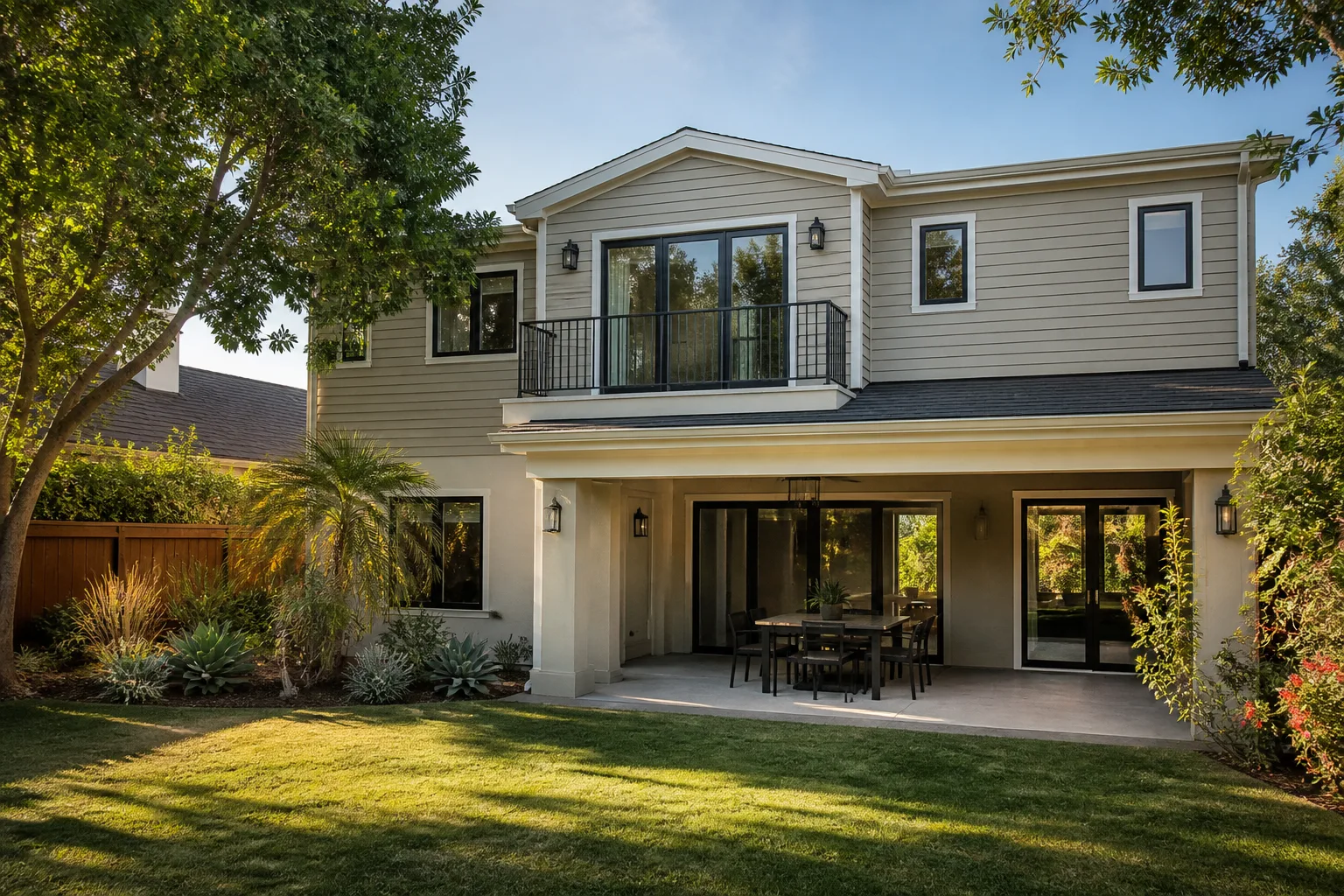
A room addition in Las Vegas is a long-term asset that needs a 12-month inspection cycle to protect. The roofline transition, stucco seams, and HVAC capacity are the three failure points that cost the most when missed, and all three show their first signs after a full summer. Use the calendar in this guide, photograph everything on a schedule, and claim warranty work in writing before the year is up. If your contractor has gone silent, the sequence above gives you leverage. If you’re planning the build, the right contractor writes the price, the permit, and the guarantee down before starting. Plan the build method around your budget and lot – whether that’s a prefab platform like Boxabl or Mighty Buildings, or a conventional build with James Hardie siding – and get the details graded before work starts. Call (888) 418-2161 for a free estimate on any room addition or repair scope in Las Vegas.
Written by the team at Fielding ADU Builders Las Vegas.