Last updated November 18, 2026
ADU Builders Warning Signs Every Homeowner Should Know
Nevada’s residential construction category sits at the top of the State Contractors Board’s homeowner complaint list, and most of those complaints trace back to the same gap: no written scope of work before the job began. That detail matters more than any license number, any handshake, any promise of “we know the inspectors.” Las Vegas homeowners building an ADU are committing to a project that can run well into six figures and reshape the value of their lot. The contractors most likely to leave you with an unpermitted structure, a stalled slab, or a finished shell that fails final inspection are not advertising that outcome. They win the bid with a low number and vague paperwork. This guide names the specific warning signs so you can spot them before you sign.
Quick Answer
The biggest ADU contractor warning signs in Las Vegas are a bid 30% below local market, a contract with no permit responsibility clause, no payment schedule tied to inspection milestones, and no written completion date. Any one of those is a reason to slow down. Two or more together is a reason to walk away.
Table of Contents
- What a Low-Ball ADU Bid Actually Tells You
- “We Work Directly With the County” Is a Red Flag, Not a Selling Point
- Contract Red Flags Specific to ADU Projects
- When a General Contractor Is Flipping Your Job to Unlicensed Workers
- How to Verify an ADU Contractor in Three Steps
- Las Vegas-Specific Build Problems Cheap Contractors Ignore
- Prefab ADU Pitfalls: What the Platform Brands Don’t Tell You
- Reading an ADU Timeline Honestly
What a Low-Ball ADU Bid Actually Tells You
An ADU bid that lands far below every other quote in your folder isn’t a deal. It’s a signal. In the Las Vegas market, a legitimate detached one-bedroom ADU built conventionally typically runs in the range of $180 to $275 per square foot before permit fees, utility trenching, and site prep. Attached units and garage conversions can come in lower per foot because the shell and slab already exist. A bid that comes in at roughly 30% under those figures isn’t being generous with your money. It’s being generous with a number that will not hold.
The mechanics are predictable. The contractor writes a low number to win the job, then recovers margin through change orders once demolition has started and you are structurally committed. New electrical panel? Extra. Soil conditions require over-excavation? Extra. The city wants a drainage plan? That’s a change order. By the time the last invoice lands, you’ve paid market rate plus the cost of your own exhaustion.
In our experience, the cheapest ADU bids also carry the thinnest scope documents. Here’s what a real Las Vegas ADU scope of work should itemize:
- Site work: grading, utility trenching, and haul-off for excavation spoils
- Foundation: the engineered slab or footings spec, including any caliche removal
- Structure: framing, sheathing, and the siding product by brand and profile (James Hardie is common for freeze-thaw durability here)
- MEP: rough-in electrical, plumbing, HVAC, and panel capacity
- Permits and fees: stated separately with a named responsible party
- Finishes: flooring, cabinets, countertops, fixtures, by category
- Exclusions: spelled out, not implied
Fielding ADU Builders is the ADU and room-addition specialist inside the Garrison Partners family, and we’ve built to The Garrison Standard since 2006. That standard means a written price before a single nail is driven, no change orders moving the number at the door, and the number you approve on day one is the number on the final invoice. If a bid you’re comparing doesn’t put those items in writing, you’re not comparing bids. You’re comparing wish lists.
“We Work Directly With the County” Is a Red Flag, Not a Selling Point
When a contractor tells you they have a personal relationship with the county inspector, that’s not a shortcut. It’s a warning. Permits in Clark County are public record. Inspections are scheduled on a calendar, not granted as a favor. A contractor claiming they “know the inspectors” is telling you they either don’t understand how the process works or they’re hoping you don’t.
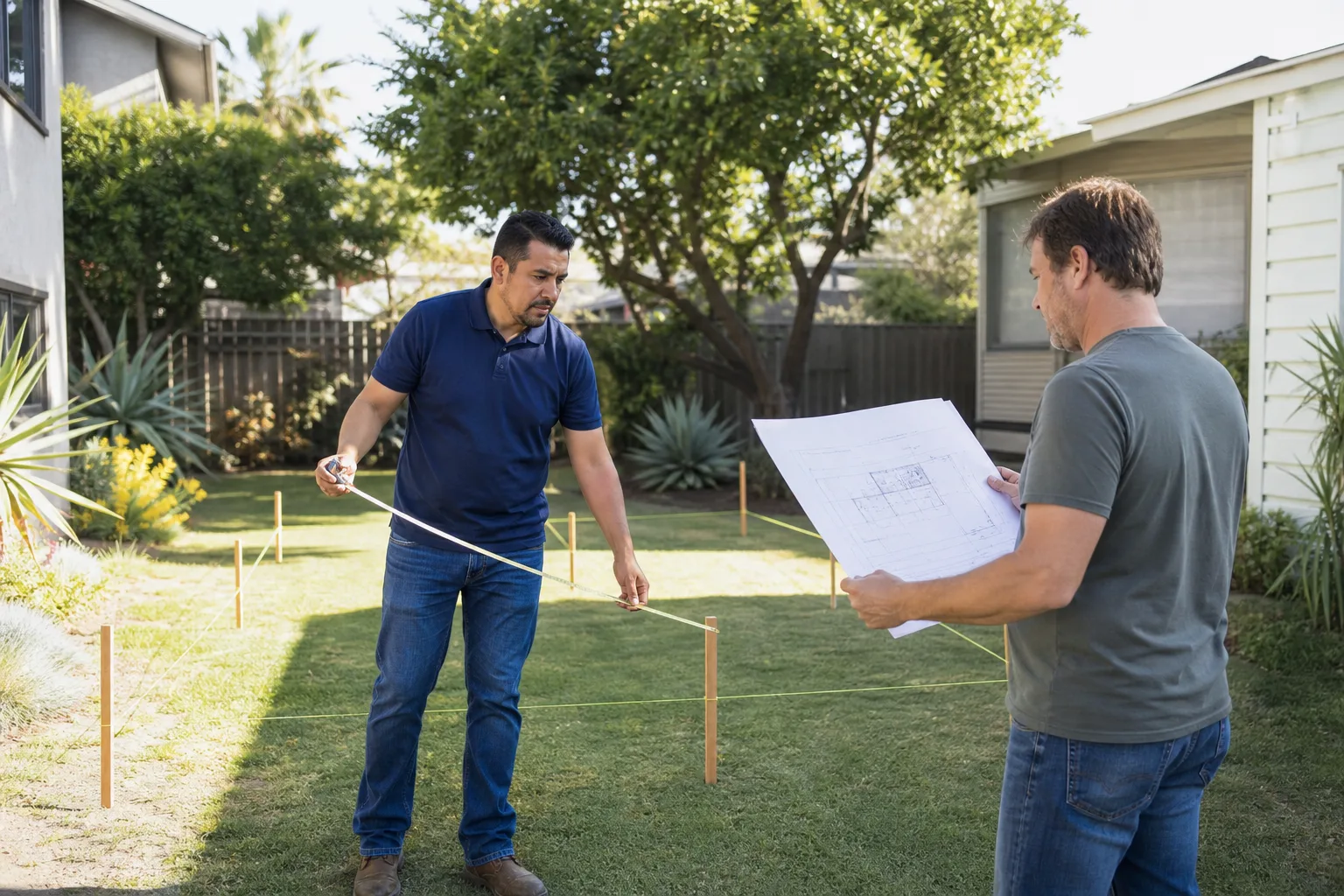
Here’s the honest version of how permits, variances, and inspections actually work on a Las Vegas ADU:
- Zoning review. A detached ADU has to fit the setback rules for your parcel. If it doesn’t, you need a setback variance, which is the city’s written permission to build closer to the property line than the standard rule allows. That’s a filed application, a public notice, and a hearing date – not a phone call to a buddy.
- Building permit application. Plans, structural engineering, and sometimes energy compliance documentation go to the county. The clock starts when they receive a complete submittal, not when a contractor promises to “get to it.”
- Plan review. A permit technician, then a plan examiner, reviews the set. Corrections come back in writing. The contractor addresses them.
- Permit issued. Now work can legally begin. Any framing, pouring, or trenching that happened before this document exists is unpermitted work.
- Inspection milestones. Foundation, framing, rough-in MEP, insulation, and final. Each inspection is a checkpoint. Each one is public record with a date.
Any contractor who treats that sequence as a bureaucratic obstacle instead of a step-by-step is telling you how they operate. By the book, or around it. If you want a Clear read on that distinction, our ADU builders in Las Vegas page walks through how a permitted build actually sequences.
Contract Red Flags Specific to ADU Projects
ADU contracts fail on the paperwork long before they fail on the construction site. Here are the clauses to look for – and to walk away from if they’re missing.
The missing permit responsibility clause
Your contract must name who pulls the permit and who pays for it. If the clause is silent or says “permits are the homeowner’s responsibility,” the contractor has written themselves a get-out. A homeowner who has never filed a permit before is now responsible for a code compliance sequence they don’t understand. In our experience, the contractor who pulls the permit also wants the inspection record to be clean under their own name. That’s the right incentive structure.
The vague payment schedule
A proper schedule ties draws to inspection milestones, not to calendar dates. Foundation poured and inspected, then a draw. Framing complete and inspected, then a draw. If the schedule says “20% on signing, 30% at month two, 30% at month four,” that’s a schedule built to pay the contractor’s overhead, not to match the work on site. Compare that to a schedule tied to inspection sign-offs and you can see which one protects the person holding the money.
No written completion date
A timeline without a date is a hope. Your contract should state a substantial completion date and describe what happens if it slips – how notice works, what remedy applies. “We’ll be done in the spring” is not a date. If the contract won’t commit, ask why.
No written guarantee
Workmanship defects are not covered by manufacturer warranties. If something fails on your ADU in month eight because a flashing detail was wrong, the siding manufacturer isn’t coming back. The contractor who built it should be. The Garrison Standard covers workmanship for a full year in writing: if it isn’t done right, we come back and make it right at no charge. That’s a 365-day guarantee spelled out on paper – what it covers, how long it runs, and how the fix happens. Ask any contractor you’re evaluating to put the same in writing. Most won’t.
If you’re weighing a smaller project, our garage conversion contractor in Las Vegas page covers the contract language and inspection sequence that apply to conversions, which have their own traps around existing slab thickness and egress.
When a General Contractor Is Flipping Your Job to Unlicensed Workers
A legitimate ADU build involves a general contractor and a set of specialty subcontractors. Framing, electrical, plumbing, HVAC, drywall, finishes – a real GC manages that chain and is accountable for every trade. That’s normal. What’s not normal is a GC who subcontracts everything to the lowest bidder with no verification of credentials, then leaves the homeowner to sort out a failed inspection with an electrician who was paid in cash.
Here’s how the two chains look side by side:
- Legitimate chain: a named GC with a current NSCB license, specialty subs who are individually licensed where Nevada requires, written subcontracts on file, background-checked crews arriving in uniform, and one point of contact who answers the phone
- Churned chain: the GC shows up for the contract signing, then disappears into another job, while an unlicensed framing crew sets the walls. The drywall sub never received plans. Nobody knows who poured the slab. The phone rings to voicemail.
If you’re never introduced to the subs, ask to be. A contractor with nothing to hide will name them, confirm they’re licensed, and put the crew on the calendar so you know who’s arriving and when. At Fielding ADU Builders, every crew member on your site has been background-checked and arrives in uniform, so you know exactly who is working on your property. That’s a small thing until the day it isn’t.
How to Verify an ADU Contractor in Three Steps
You don’t have to trust a sales pitch. You have three public-data checks that will tell you most of what you need to know before you ever sign.
Step 1: NSCB license check
Go to the Nevada State Contractors Board website and look up the license number. Confirm three things: the license is current, active, and issued to the contracting entity that’s bidding your job – not a parent company with a similar name. Check the classification, because the classification determines what work the license permits. Check for any disciplinary actions or complaints on file. This is a five-minute lookup that rules out a huge share of the contractors you’ll be tempted by.
Step 2: Lien history check
Ask for a lien history from the contractor, and check the Clark County Recorder’s office for recorded liens against the entity. Liens on a contractor usually mean subs or suppliers went unpaid on prior projects. That’s a signal the contractor’s cash flow relies on the next job’s money – which means your job’s money may pay for the last one. A clean lien history doesn’t guarantee a good outcome, but a messy one is a hard no.
Step 3: Pull the permit yourself
This is the most useful check in the whole process. Go to the Clark County building department’s public permit portal and search your address. If the permit exists, you can see who pulled it, when, what inspections have been recorded, and whether any corrections or stop-work notices are attached. If the permit doesn’t exist, the contractor hasn’t submitted it – regardless of what they tell you on a phone call. Any work that has started without an issued permit is unpermitted work, and it will follow you through refinancing and resale.
If you’re considering a connected addition, our room addition contractor page for Las Vegas covers the same verification steps and adds the structural items that apply to attached projects.
Las Vegas-Specific Build Problems Cheap Contractors Ignore
Las Vegas is one of the toughest environments in the country for a small building, and cheap ADU contractors cut the details that matter here more than they would anywhere else. Those shortcuts don’t show up in month one. They show up in year three.
- Caliche. A lot of valley parcels sit on caliche – a cemented soil layer that can be soft as chalk in one spot and hard as low-grade concrete in another. Proper site work means knowing what you’re building on before you pour. A contractor who quotes foundation cost without testing is quoting a number they can’t stand behind.
- Summer heat load on the envelope. Interior temperatures inside an undersized or under-insulated ADU can make the space unusable for half the year. Undersized minisplits, no ridge ventilation, and single-pane windows are the standard shortcut package. In our experience, spring and early summer failures on ADUs we’re called in to assess almost always trace to HVAC sizing, not equipment failure.
- Monsoon-driven water intrusion. A hard monsoon push against a wall with an improperly lapped WRB, a missing sill pan, or a flat roof without scuppers will find the weakness. Cheap contractors skip the flashing details because they’re invisible after the siding goes up. Las Vegas monsoon water intrusion is the number one call we get that a good envelope would have prevented.
- Dust and prevailing wind. Wind-blown dust and fine sand find their way into any gap. Windows, doors, and penetration seals are the difference between a sealed envelope and a slow leak of valley grit into your new living room.
- Utility trenching. A detached ADU needs electrical, water, and sewer run from the main house. Some contractors leave that line out of the bid and spring it as a change order – often $8,000 to $18,000 depending on distance and obstacles. Confirm it’s in the scope before you sign.
Every item above is an inspection-visible detail on a proper build. All of them are invisible on a low bid.
Prefab ADU Pitfalls: What the Platform Brands Don’t Tell You
Prefab and modular ADUs have become a real option in Las Vegas, and the platform brands you’re likely researching – Abodu, Cover, Dvele, Mighty Buildings – make good products. The house is the easy part. The site is where projects go sideways.
A prefab ADU quote covers the structure and its delivery and set. It usually does not cover the site preparation, the utility trenching, the permit filing under a Nevada-licensed GC, the foundation engineering for your specific lot, or the crane and staging access on the delivery day. That gap – between the platform price and the installed cost – is where a lot of Las Vegas homeowners get surprised.
When you’re evaluating a prefab option, ask these three questions:
- Who is the Nevada-licensed GC of record? The platform may have a regional partner. Confirm the partner is licensed and confirm they’re pulling the permit under their name.
- What’s itemized outside the platform price? Site work, foundation, utility trenching, crane cost, and landscaping restoration. Get each of those in a separate written line.
- Who handles the inspection sequence? Prefab installs still go through foundation, MEP rough-in, and final inspection. The platform sells the shell. Someone local has to walk the permit.
We work with Abodu, Cover, Dvele, Mighty Buildings and other leading platforms, plus conventional builds using materials like James Hardie siding, so we can match the right method to your lot and budget. If you want to understand how the conventional vs. prefab decision looks side by side, our Fielding ADU Builders Las Vegas home page covers both paths in more detail.
Reading an ADU Timeline Honestly
An honest timeline accounts for things the contractor can’t fully control. A dishonest one promises speed. Here’s a realistic Las Vegas ADU timeline, assuming a straightforward lot and a complete plan set:
- Design and engineering: 6 to 10 weeks
- Permit submittal and plan review: 8 to 16 weeks, longer if you need a setback variance
- Site work and foundation: 3 to 5 weeks
- Framing and dry-in: 4 to 6 weeks
- MEP rough-in and inspections: 4 to 6 weeks
- Insulation, drywall, and finishes: 6 to 10 weeks
- Final inspection and punch list: 2 to 4 weeks
Total from signed contract to move-in-ready ADU: 8 to 14 months is realistic. A contractor who promises 4 months is either lying, or building unpermitted. Neither is what you’re looking for.
Common Mistakes to Avoid
- Signing without a written scope of work. The Nevada State Contractors Board report on residential complaints almost always traces back to this one gap. If the scope isn’t in the contract, it isn’t covered.
- Paying a large deposit to “hold your spot.” ADU projects don’t require large upfront deposits. A reasonable deposit protects the contractor’s mobilization cost. A 30% or 40% ask up front is cash-flow, not scheduling.
- Accepting “we’ll pull the permit once we get started.” In Las Vegas, the permit is a public record with a date on it. Any work that starts before the permit is issued is unpermitted work, and the record follows the property.
- Taking a bid 30% under market without asking why. The bid tells you the contractor’s margin strategy. A low bid is a margin recovery plan disguised as a price.
- Skipping the lien history check. A contractor with prior recorded liens is telling you how they manage their obligations. Believe the record.
- Not asking for the workmanship guarantee in writing. A verbal guarantee expires when the crew drives away. A written guarantee with a defined term is the only one that survives.
- Hiring on personality. The most personable contractor isn’t necessarily the one who pulls the permit, prices in writing, and answers the phone in month nine when a defect shows up. Judge the paperwork, not the handshake.
When to Call a Professional
Some of the decisions above need a second set of eyes. If you’ve received a bid that came in well under your other quotes, call before you sign. If your contract has no payment schedule tied to inspection milestones, call before you pay anything. If your current contractor has started work without a permit posted on the property, call before the next milestone. If a prior contractor’s job was abandoned mid-build, call before you hire someone to finish it – finish work on an unpermitted shell is a different project than a fresh build. If you’re trying to decide between a prefab platform and a conventionally built ADU and want the installed cost side by side, call for a free estimate. Fielding ADU Builders offers free estimates in Las Vegas – call (888) 418-2161. Every call is answered by a live person, 24 hours a day, 7 days a week.
Frequently Asked Questions

A bid that comes in 30% or more under every other quote, with a contract that has no written scope of work. That combination is the strongest early signal that change orders will recover the margin. Call (888) 418-2161 for a free second-opinion estimate if you want to compare.
Yes. Permits and inspections in Clark County are public record and scheduled by calendar, not by favor. A contractor who claims a personal relationship with inspectors is either misunderstanding the process or evading it. Either way, verify the permit yourself through the county portal.
No – which is why it’s worth asking for. At Fielding ADU Builders, every addition and ADU is backed in writing for a full year under The Garrison Standard: if it isn’t done right, we come back and make it right at no charge. Ask any contractor you’re comparing to put the same term in writing.
Pull it yourself. Go to the Clark County building department’s public portal, search your address, and confirm the permit is issued under your contractor’s name with a date that predates site work. If it isn’t there, it wasn’t pulled.
Conventional detached ADUs typically land in the range of $180 to $275 per square foot before permit fees and utility trenching. Garage conversions and attached units can come in lower because the shell exists. Tax credits, platform pricing, and site-specific items will move that number, which is why we put the actual figure in writing before any work starts. Call (888) 418-2161 to schedule your free estimate.
Finish work on a partially completed ADU is possible, but the first step is pulling the permit record to see what was actually inspected and what wasn’t. Call (888) 418-2161 for a free assessment of the existing work before you hire anyone to complete it.
The Bottom Line
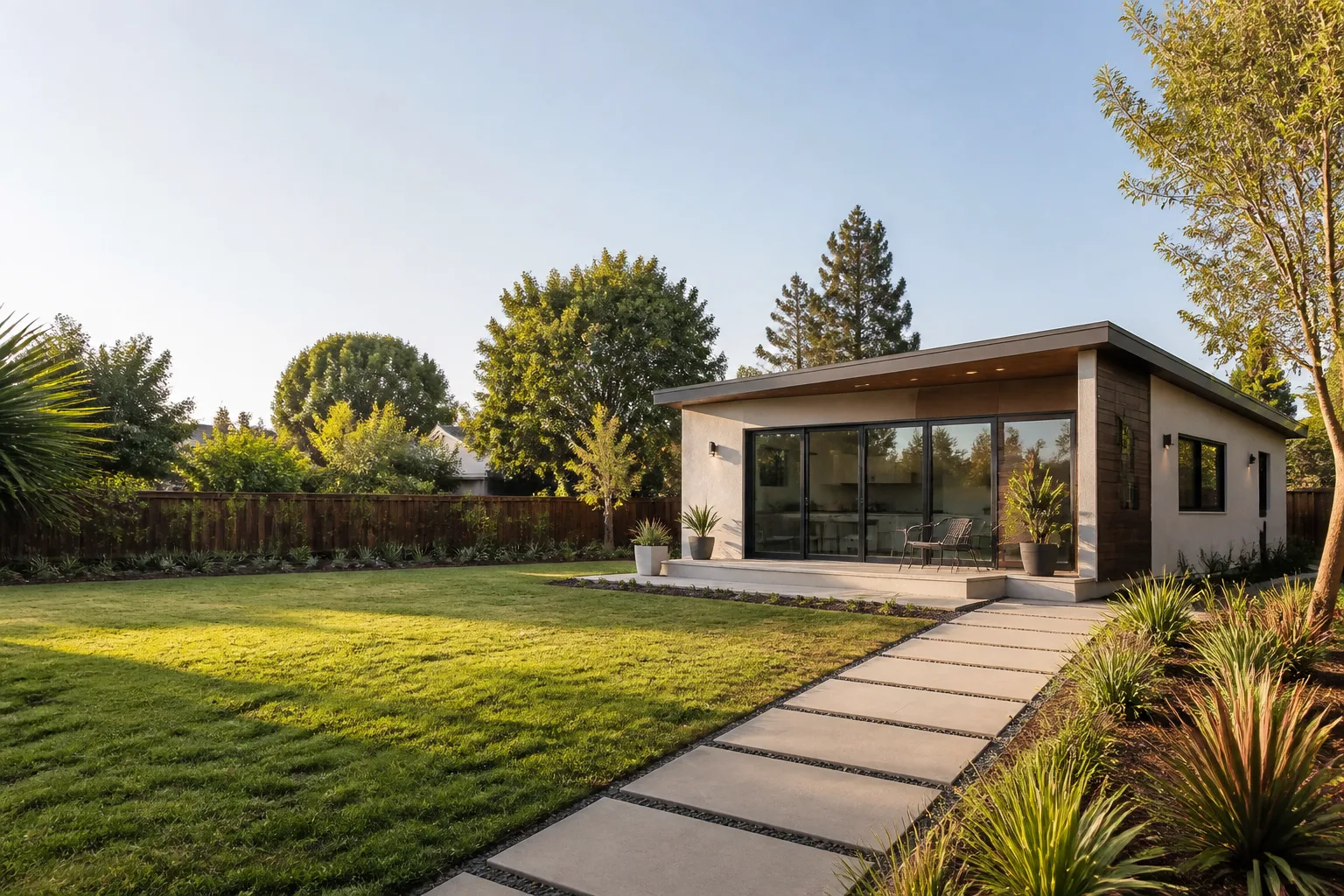
The ADU contractors most likely to hurt you don’t look dangerous on day one. They look like the cheapest bid in your folder. Your protection is three checks you can run yourself – the NSCB license lookup, the Clark County lien recorder, and the permit portal – plus a contract that puts the permit responsibility clause, inspection-tied payment schedule, written completion date, and workmanship guarantee in front of you before you sign. Any one of those missing is a reason to slow down. Two or more is a reason to walk. Build the ADU you’ll still be happy with in ten years. The paperwork is where that decision actually gets made.
Fielding ADU Builders Las Vegas connects Las Vegas homeowners with independent, licensed local professionals who build permitted ADUs, garage conversions, and room additions – with a written price before any work starts and The Garrison Standard’s one-year written guarantee on the workmanship. Every call is answered by a live person, and the crew on your site has been background-checked and arrives in uniform. Call (888) 418-2161 for a free estimate and a written line-item price before you compare anything else.
Written by the team at Fielding ADU Builders Las Vegas.