Last updated November 18, 2026
Garage Conversion Contractor Warning Signs Every Homeowner Should Know
Nevada state law requires a written contract for any home improvement job over $1,000. If your garage conversion contractor hasn’t handed you one before the first nail goes in, you’re already in trouble. That single fact catches more Las Vegas homeowners than any other, and it’s why the warning signs in this guide matter. The contractor who looks dangerous rarely is the problem. The one who looks affordable, offers to “handle permits after the fact,” and quotes a price $15,000 under everyone else is the one who leaves you with an illegal structure the county can order you to tear down. Here’s what to watch for before you sign anything.
Quick Answer
The biggest warning signs of a bad garage conversion contractor are: no written contract before work starts, an offer to pull permits “later” or skip them, vague scope language that doesn’t name each trade, cash-only payment or a large upfront deposit, an unverifiable license, and no physical business presence you can check. In Las Vegas, the “we’ll pull permits later” line is the single most expensive phrase you can hear, because retroactive permitting through Clark County often costs two to three times what a proper upfront permit runs and can force demolition of finished work. Call (888) 418-2161 for a free estimate from a contractor who prices in writing before any work begins.
Table of Contents
- 1. The “We’ll Pull Permits Later” Pitch
- 2. An Unverifiable Nevada Contractor’s License
- 3. Vague Scope-of-Work Language in the Contract
- 4. Cash-Only Demands and Large Upfront Deposits
- 5. What a Real Clark County Permit Packet Looks Like
- 6. No Physical Presence or Verifiable Track Record
- 7. The Walkthrough They Won’t Give You
- Common Mistakes to Avoid
- When to Call a Professional
- Frequently Asked Questions
1. The “We’ll Pull Permits Later” Pitch
This is the phrase that costs Las Vegas homeowners the most money, and it always sounds reasonable when it’s said. The contractor leans in, lowers their voice, and explains that pulling a permit now will “slow everything down” or “add $8,000 to the price.” They offer to do the work first and “square it up with the county after.” What they don’t tell you is what happens next.
A garage conversion is not a cosmetic update. It changes the legal use of a structure, adds habitable square footage, and touches electrical, plumbing, HVAC, and structural systems that Clark County inspects at specific stages. When work is done without permits, you end up with an unpermitted structure, and unpermitted structures create three problems that compound:
- Retroactive permitting costs more. The county requires exposed framing, open walls, and often destructive testing to verify what’s behind the drywall. In our experience, retroactive permitting on a completed Las Vegas garage conversion typically runs $12,000 to $25,000 in corrections and fees, against a few thousand for the original permit.
- You may have to open finished walls. Inspectors need to see the work. That means cutting into drywall, pulling up flooring, and redoing finishes you already paid for.
- Sale and refinance problems. Title companies and lenders flag unpermitted square footage. A garage conversion that isn’t on record can stall a sale, reduce your appraisal, or force you to disclose the issue to every future buyer.
The worst case isn’t a fine. It’s a demolition order. Clark County can require that unpermitted work be removed entirely if it can’t be brought into compliance. We’ve seen homeowners in the eastern Las Vegas Valley pay to build a conversion, pay again to tear it out, and pay a third time to do it right. That’s a $40,000 mistake built on a five-minute conversation about “saving time.”
The phrase itself is the red flag. A licensed contractor in Nevada either pulls the permit or doesn’t take the job. There is no legitimate middle ground. If you’re comparing bids and one contractor’s number looks dramatically lower, ask directly: “Is the permit and inspection cost included, line by line?” Then watch the answer carefully.
2. An Unverifiable Nevada Contractor’s License
Nevada requires any contractor performing work over $1,000 to hold a valid state contractor’s license issued by the Nevada State Contractors Board (NSCB). The license number must appear on the written contract, on bids, and on any advertising. That’s not a suggestion; it’s the law, and it’s the first thing you should verify.
The good news is that checking a license takes under two minutes, and it’s free. Here’s the exact process:
- Go to the Nevada State Contractors Board website and open the license lookup tool.
- Enter the contractor’s license number exactly as it appears on their bid or contract. Don’t accept “we’re licensed in another state” or “we’re a Nevada company” as an answer. You need the number.
- Check the license status. “Active” means they’re cleared to work. “Expired,” “suspended,” or “revoked” means they are not, regardless of what the bid says.
- Check the classification. Nevada licenses are issued by trade and dollar limit. A license classified for general building is different from one limited to handyman work. Make sure the classification matches a garage conversion.
- Look at the complaint history and disciplinary actions. Any licensed contractor can have a bad job in their past, but a pattern of unresolved complaints tells you something the sales pitch won’t.
- Verify the qualifier. Nevada requires a “qualifying party” who personally holds the license credentials. Ask who that person is and confirm they’re listed on the state record.
If the contractor hesitates, gives you a number that doesn’t return results, or claims the license belongs to a “partner company,” stop. Nevada law allows homeowners to recover money through the NSCB’s residential recovery fund, but only against licensed contractors. If you hire an unlicensed one, you have no recourse when the work fails.
If you’re working with a contractor on any part of a Room Addition Contractor in Las Vegas project alongside a conversion, ask the same license question about each trade on the job.
3. Vague Scope-of-Work Language in the Contract
A contractor who wants to change the price mid-project needs one thing: a contract that leaves room to argue about what was and wasn’t included. That’s precisely what vague scope-of-work language gives them. A legitimate bid names every trade involved and puts a dollar figure next to each one.
Here’s how to tell the difference. This is what a bad scope line looks like: “Convert garage to living space, including electrical and drywall, for $32,000.” That sentence has at least six hidden arguments inside it. Who supplies the drywall? Is HVAC part of “living space”? Does “electrical” include the panel upgrade your conversion will almost certainly require?
A real garage conversion bid in Las Vegas breaks out each trade with a line-item cost:
- Demolition and haul-off: quantity and disposal fee
- Framing and structural work: new walls, headers, and any beam work
- Insulation: R-value specified for Las Vegas climate (more on that below)
- Drywall: hanging, taping, finishing, and texture type
- Electrical: panel capacity, outlet count, circuit and fixture schedule
- HVAC: ducting, equipment, or mini-split model and capacity
- Plumbing: scope if a bathroom or kitchenette is included
- Flooring: material and square footage
- Permits: Clark County permit fees and inspection costs, separately stated
- Labor vs. materials: itemized, not lumped
When you have this level of detail, you can compare two bids meaningfully. When you don’t, you’re comparing a fantasy number to a real one, and the fantasy one always wins the first round. That’s the trap.
One Las Vegas-specific detail worth checking in the scope: the insulation R-value. Summer attic temperatures here regularly exceed 140 degrees, and a garage conversion with standard R-13 walls will bake in July and overwork the HVAC in August. The correct specification is R-15 or better in the walls and R-38 or better overhead. If the bid doesn’t specify, ask. If the contractor can’t answer, that’s a problem.
4. Cash-Only Demands and Large Upfront Deposits
Nevada law sets specific limits on what a contractor can demand upfront, and it protects you from cash-only operations. Under Nevada contractor law, a contractor cannot collect more than a specified percentage of the contract value as a down payment before work starts, and that percentage is written into the state rules. Any contractor who wants 50 percent upfront is either ignoring the law or doesn’t know it.
The deposit structure of a legitimate garage conversion in Las Vegas typically looks like this:
- A modest deposit at contract signing, sized to cover permit fees and initial material orders
- Progress payments tied to specific completed milestones (demo done, framing inspected, rough-in inspected, drywall hung, final inspection)
- A final payment held until the punch list is complete and the final inspection passes
What you’re looking for is the payment tied to work, not to a calendar date. The clause to watch for reads something like “balance due 30 days from start of work.” That’s a red flag. Thirty days might land before the job is finished, and once the contractor has your final payment, the incentive to come back and fix a defect disappears.
Cash-only demands are a separate and equally serious warning sign. A licensed contractor can accept cash, but refusing checks or electronic payment isn’t about convenience. It’s about leaving no paper trail. That becomes your problem in three ways: no record of what you paid, no ability to recover funds if the work fails, and no path to a warranty claim. Every legitimate contractor operates on a written contract with named payment milestones and a documented transaction history. If the payment method is cash-only, and there’s no written contract, and the price is dramatically lower than competing bids, you’re looking at a scam shaped like a discount.
5. What a Real Clark County Permit Packet Looks Like
Homeowners get told “we’ve submitted the permits” and have no way to verify it. That’s the whole reason the “we’ll pull permits later” scam works. Here’s how to check. A genuine Clark County ADU or garage conversion permit packet is a specific set of documents, and a real contractor will show you what was filed.
The packet should include:
- A plot plan or site plan showing the existing structure, the proposed change, and setbacks from the property lines
- Architectural drawings stamped by a Nevada-licensed architect or engineer, showing floor plans, elevations, and sections
- Structural calculations where any load-bearing change is involved (headers, beams, garage door infill)
- Title 24 energy compliance documentation (California’s energy code, applied to Nevada as alternate compliance in many Clark County permits)
- Electrical, plumbing, and mechanical drawings specific to the proposed conversion
- A sworn statement and owner authorization form signed by the property owner
- The permit application number and current status you can look up yourself through the county’s online portal
If your contractor can’t show you the submitted packet or the permit number, they haven’t submitted anything. Full stop. “It’s in process” means nothing without a number you can verify.
The homeowner-side check is simple: once you have the permit number, log into the county’s permit portal and pull up the status. You’ll see whether the application is under review, approved, or has failed for corrections. You’ll also see the inspection history once work begins. If your contractor won’t give you the number, they’re protecting something.
One more Las Vegas-specific note: garage conversions in older Las Vegas neighborhoods, particularly in the 89107, 89108, and 89115 zip codes, sometimes trigger a review for asbestos in demolition if the home predates 1980. A real permit packet will flag this. A fake one won’t.
6. No Physical Presence or Verifiable Track Record
A licensed contractor in Nevada has a physical business address, a phone number that’s answered by someone who works there, and a paper trail of permits and jobs you can check. A scam operator has a phone number that stops working after the deposit clears.
Here’s what to verify before you sign:
- Get the contractor’s business address and check it on a map before you call back. A residential address is fine. A vacant lot, a PO box, or an address that doesn’t match is not.
- Call the phone number and time how fast someone picks up. Our crews answer every call with a live person, and that’s the standard to expect from a contractor who plans to be reachable when something goes wrong six months in.
- Ask for three recent addresses of completed garage conversions in Las Vegas, then drive by. Note the ones you can see from the street. A contractor with ten finished jobs can find three. A scammer can’t.
- Look up the contractor’s name and license number in the NSCB records and search for complaint history. Real contractors have real records. Fake ones have no history at all.
The “vanishing contractor” scenario is a known pattern in the Las Vegas market, especially in fast-growing areas on the edges of the valley. A crew shows up, finishes the demo, collects the next progress payment, and disappears. The homeowner is left with an open, unpermitted structure and no recourse but the small claims process, which costs months and rarely recovers the money. A verifiable address and a live phone line don’t prevent that entirely, but they’re two checkpoints a scam operation can’t fake.
7. The Walkthrough They Won’t Give You
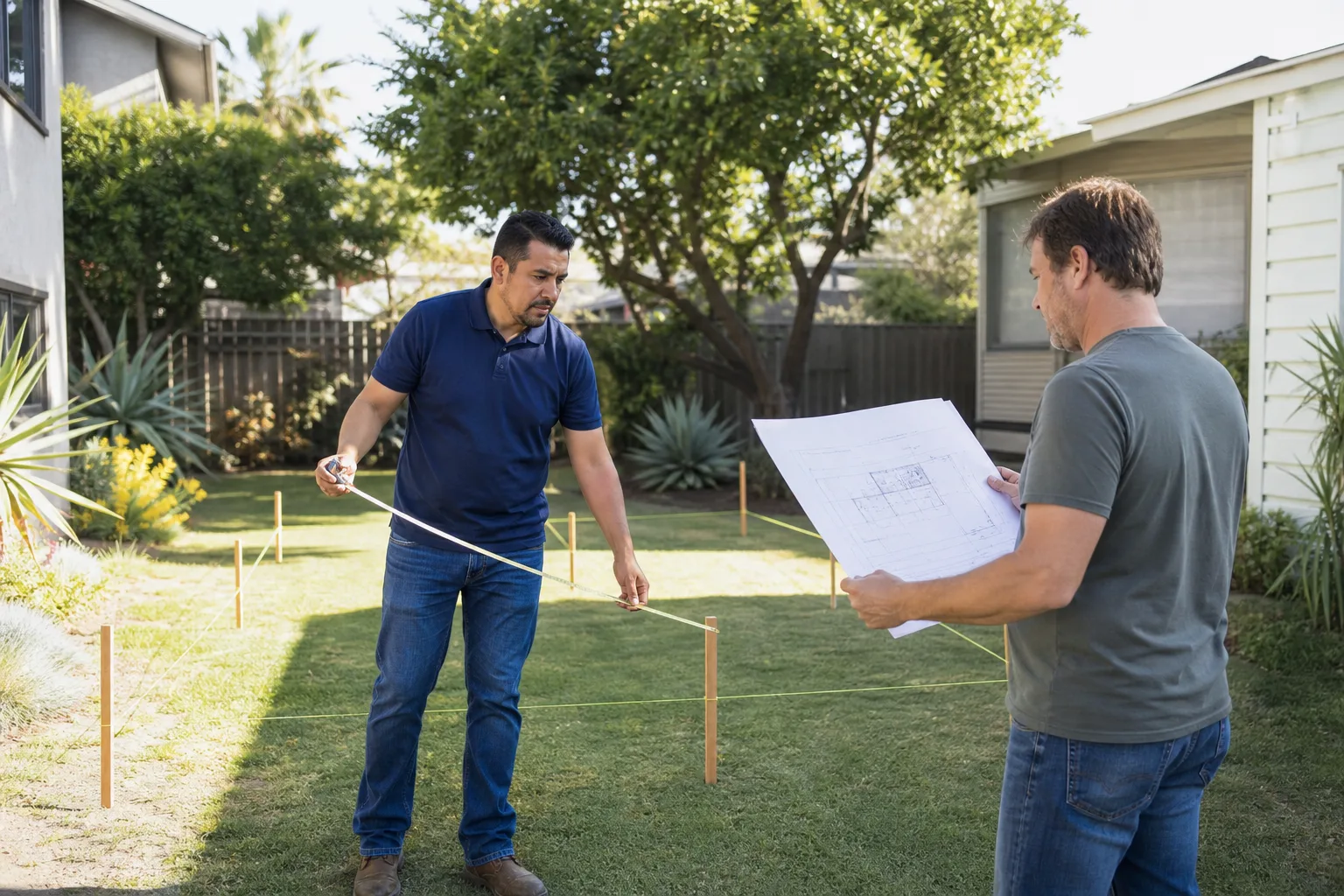
A serious contractor will walk the property with you before quoting. They’ll pull string lines, look at the concrete slab condition, check the electrical panel capacity, and point out where the header or beam will need to go. A contractor who quotes your garage conversion without ever seeing your garage isn’t pricing your job. They’re pricing a guess.
The walkthrough isn’t a formality. Three specific things it should cover in a Las Vegas home:
- Slab condition. Las Vegas garages are often on a slab with no vapor barrier. If moisture is pushing up through the slab, that has to be addressed before flooring or framing. A contractor who never looks for it will discover it later and bill you for the fix.
- Electrical panel capacity. A garage conversion adds circuits for lighting, outlets, and an HVAC system. Older Las Vegas homes in neighborhoods like Lakes or Spring Valley sometimes have panels that max out. A panel upgrade is a real cost and needs to be in the bid, not discovered later.
- HVAC routing. The garage is typically on the far end of the house from the air handler. Ducting a garage conversion properly means calculating runs and possibly adding a dedicated mini-split. If the contractor doesn’t walk to the mechanical equipment and check, the HVAC number in the bid is a guess.
We’ve walked into garages in places like North Las Vegas where the homeowner had already accepted a phone quote. Three minutes in, the slab had visible cracking and the panel was full. The proposal they’d signed was $11,000 short on scope, and the contractor had no intention of honoring it. That’s why the walkthrough is non-negotiable. Any contractor who won’t walk the property with you before quoting is telling you what their proposal is worth: nothing.
If your project involves a full ADU rather than a garage conversion, the same warning signs apply. Learn about ADU Builders in Las Vegas and the differences in scope, permitting, and platform options like Abodu and Plant Prefab.
Common Mistakes to Avoid
- Signing a contract that doesn’t name the trades. A lump-sum price with no line items gives the contractor unlimited room to argue about what was included. Insist on framing, electrical, HVAC, insulation, drywall, and permits priced separately before you sign.
- Paying cash before you’ve seen a permit number. No permit, no payment. The permit number is the single most enforceable protection you have, and it costs you nothing to check. Ask for it the day the contract is signed.
- Accepting “we’ll pull permits later” as a scheduling detail. It isn’t. It’s the mechanism by which a cheap bid becomes an expensive problem. There’s no legitimate reason a licensed contractor can’t pull the permit before the crew arrives.
- Hiring the lowest bid without comparing scope. A bid $15,000 under the others is a bid that omits $15,000 of work. Compare line by line, not total by total, and ask each contractor to explain gaps.
- Skipping the state license check because the contractor seems professional. The license check takes two minutes on the NSCB website. Do it before you sign, not after the first payment. A revoked license doesn’t show up in a conversation.
- Hiring a crew you can’t find again. No physical address, no verifiable permit history, no local references you can drive past. If it’s hard to find them now, it will be impossible after the deposit clears.
- Ignoring the HVAC and insulation math in Las Vegas. A conversion spec’d to minimum code in a mild climate will struggle here. R-38 in the ceiling and a properly sized mini-split aren’t upgrades; they’re the baseline for a habitable room in July.
When to Call a Professional
Call a licensed contractor before you sign anything, not after. That’s the counsel that saves the most money. If you’ve already got a bid that looks too good, a contractor pushing you to pay cash, or a proposal that mentions “permits later,” call before a single nail goes in. If you’re planning a garage conversion in Las Vegas and want a second opinion on another contractor’s bid, we’ll review it with you at no charge. If you’re weighing a prefab platform like a Tuff Shed shell or an Abodu unit against a conventional build, we’ll walk you through the trade-offs. Fielding ADU Builders Las Vegas offers free estimates in Las Vegas: call (888) 418-2161. Every project comes with a written price before any work starts and The Garrison Standard’s one-year written guarantee. If something fails inside that year, we come back and fix it at no charge.
Frequently Asked Questions
Check three things in order: the Nevada State Contractors Board license number, the Clark County permit application, and a written contract with trade-by-trade line items. All three are verifiable before you pay anything. A legitimate contractor will hand all three to you without being asked twice. If any one of them is missing or “in process,” slow down. Call (888) 418-2161 for a free estimate and we’ll walk you through exactly what to verify.
You end up with an unpermitted structure that can complicate a sale, refinance, or insurance claim, and Clark County can order corrections or demolition. Retroactive permitting typically requires opening walls and exposing framing for inspection, which costs two to three times what an upfront permit runs. In our experience, the corrections and fees usually land between $12,000 and $25,000 on top of the work you already paid for. Don’t accept a bid that offers to pull permits after the fact.
Nevada contractor law sets a cap on how much a contractor can collect before work begins, and it’s below the 50 percent some contractors request. The specific limit applies to the total contract value and is written into state rules enforced by the Nevada State Contractors Board. The safest structure is a modest signing deposit, progress payments tied to completed milestones, and a final payment held until the final inspection passes. Ask any contractor to put that schedule in writing.
A permitted garage conversion in the Las Vegas market typically runs $30,000 to $65,000 depending on size, finishes, HVAC needs, and whether a bathroom or kitchenette is included. Permit fees and inspections are a separate line item. The warning-sign bid is the one that quotes $18,000 and doesn’t mention permits at all. Call (888) 418-2161 for a written line-item estimate on your specific garage.
Yes. Converting a garage to habitable space changes the legal use of the structure and requires a permit plus staged inspections from Clark County. The permit covers framing, electrical, plumbing, mechanical, and energy compliance in the same packet. Any contractor who says the conversion doesn’t need a permit isn’t telling you the truth, and hiring them exposes you to demolition orders and sale-blocking disclosures down the line.
Not on a properly written contract. A legitimate garage conversion contract specifies the scope trade by trade, the price for each, and a change-order process that requires your written approval before any added cost is incurred. Once you’ve approved the scope and price, the number on the final invoice should match the number you signed. If your contract allows “price adjustments” without your signature, it isn’t a fixed price. Call (888) 418-2161 for a quote where the number you approve on day one is the number on the final invoice.
The Bottom Line

The most dangerous garage conversion contractor in Las Vegas doesn’t look dangerous. They look affordable, and they offer to skip the parts that would slow the job or raise the price. The warning signs are all specific and all checkable: no written contract before work starts, no verifiable NSCB license, vague scope language, cash-only demands, a deposit above the legal limit, and a permit packet you can’t confirm. Every one of those checks costs you two minutes and zero dollars. Every one of them can save you tens of thousands of dollars and months of legal trouble. Verify first, sign second, build once. If you’re evaluating a bid and want a professional second opinion, get in touch through Fielding ADU Builders Las Vegas home or start with our Garage Conversion Contractor in Las Vegas service page.
Ready for a garage conversion done right the first time? Call Fielding ADU Builders Las Vegas at (888) 418-2161 for a free estimate. We price every project in writing before a single nail goes in, and every build is backed by The Garrison Standard’s written one-year guarantee.
Written by the team at Fielding ADU Builders Las Vegas.