Last updated November 18, 2026
Room Addition Contractor Warning Signs Every Homeowner Should Know
A contractor who gives you a verbal price and says “we’ll figure out the details as we go” is describing your project’s budget trajectory, not their flexibility. That single sentence tells you more about how the next six months will go than any reference list ever could. The warnings that actually cost homeowners money rarely show up as a guy asking for cash in a parking lot. They show up as small, reasonable-sounding habits during the estimate and contract phase that predict exactly how a builder behaves when a wall opens up and the framing isn’t what the drawings promised. In this guide, we’ll walk through the subtle signals worth watching, how to read a Nevada license record step by step, and what a real itemized bid looks like. All of it written from the perspective of a Las Vegas builder who has been called in to fix the other guy’s work.
Quick Answer
The biggest room addition contractor red flags are subtle: an unwillingness to pull permits, lump-sum bids with no line items, vague or one-sided contract language, and immediate availability in a market where good builders are booked out. A contractor who discourages permits, dodges itemized pricing, or writes a contract that protects only themselves will repeat that behavior once the job is underway. Check the Nevada State Contractors Board record, insist on a written itemized bid, and treat urgency as a warning rather than a gift.
Table of Contents
- The Permit Dodge: The Single Highest-Risk Warning Sign
- Lump-Sum Bid vs. Itemized Bid: Why the Difference Matters
- How to Read a Nevada State Contractors Board License Record
- Contract Language That Protects the Contractor, Not You
- Immediate Availability in a Busy Las Vegas Market
- What the Estimate Visit Itself Should Look Like
- Schedule, Payment, and Cleanup Habits That Predict the Finish
The Permit Dodge: The Single Highest-Risk Warning Sign
When a contractor suggests you skip the permit because “it’ll just slow us down” or “the city will raise your taxes,” pay attention. That suggestion is the loudest signal you’ll get about how the rest of the job will run. In almost every case, the contractor’s motivation has nothing to do with your convenience.
Here’s what’s usually happening underneath the excuse:
- They aren’t licensed to pull the permit in the first place. A contractor without an active Nevada State Contractors Board license, or one licensed in the wrong classification for additions, can’t legally pull the permit. Discouraging permits hides that problem from you.
- They know the drawings won’t pass plan review. Room additions in Las Vegas go through Clark County or City of Las Vegas plan review, and inspectors look at structural, energy, and egress details. If the contractor’s drawings are rough sketches rather than stamped plans, they know the review will expose it.
- They don’t want the inspection schedule. Permitted work gets inspected at framing, rough-in, and final. Unpermitted work gets checked by nobody until something goes wrong.
An unpermitted addition is a liability you carry, not the contractor. If you ever sell the home, a buyer’s inspector will catch an unpermitted addition quickly, and the cost to legalize it usually falls on you. In a Las Vegas resale market where disclosure matters, that can delay a sale by months. We’ve seen homeowners in Henderson pay to tear out finished work because the framing wasn’t inspected and couldn’t be exposed without opening the walls.
The legitimate path is simple: a room addition contractor in Las Vegas should pull the permit, include the permit and inspection fees as a line item, and hand you the permit number once it’s issued. If a contractor can’t tell you which jurisdiction will issue your permit (Clark County versus city limits varies block by block in the valley), they haven’t done this often enough.
Lump-Sum Bid vs. Itemized Bid: Why the Difference Matters
A lump-sum number tells you what the contractor wants to be paid. An itemized bid tells you what you’re actually buying. Those are two different documents with two different purposes, and only one of them protects you when a change order arrives in week six.
Here’s the difference in shape. A lump-sum bid reads like this: “Room addition, 400 square feet, $148,000.” A legitimate itemized bid breaks out every phase:
- Demolition and site prep: removal of existing exterior wall, concrete cutting, haul-off.
- Foundation and slab: engineered slab or pier-and-grade beam, forms, rebar, pour, inspection.
- Framing: lumber, trusses, sheathing, labor, framing inspection.
- Roofing tie-in: matching existing roof pitch, flashing, and underlayment.
- Exterior finish: stucco, siding (James Hardie or equivalent), paint.
- Windows and doors: brand, size, U-value, quantity.
- Electrical, plumbing, HVAC: rough and finish, permits, and equipment model numbers where fixtures are involved.
- Insulation and drywall: R-value, thickness, finish level.
- Interior finishes: flooring, trim, paint.
- Permit and inspection fees: separated and named.
- Contingency or allowances: what’s included, what triggers an extra charge.
Why does this matter when change orders appear? Because the itemized bid establishes a baseline for every line. If the contractor later says the electrical was “more than we thought,” you can point to the electrical line and ask what changed. With a lump sum, every change becomes a negotiation from nothing, and the contractor controls the starting point.
For reference, a straightforward room addition in the Las Vegas Valley typically runs in the range of $250 to $400 per square foot before permit fees and finish upgrades. A 400-square-foot addition, then, lands somewhere between roughly $100,000 and $160,000 depending on structure, roof tie-in complexity, and finish level. If a bid comes in dramatically under that, ask which scope items are missing, because something is.
When a contractor hands you a written price with every line named and the number stays fixed once work begins, you’ve found the right shop. That’s how Fielding ADU Builders Las Vegas operates, and it’s the standard you should hold every bidder to.
How to Read a Nevada State Contractors Board License Record
The Nevada State Contractors Board (NSCB) publishes a public license record for every licensed contractor in the state. That record is the single most useful tool a homeowner has, and most people never look past whether a number appears. Here’s how to actually read one, step by step.
- Go to the NSCB license search. Type the contractor’s license number or the name of the business exactly as it appears on their paperwork. If a name doesn’t come up, ask the contractor for the legal business name on file.
- Confirm license status is “Active.” “Inactive,” “Suspended,” or “Expired” are all reasons to stop. An active license is the legal minimum to work as a contractor in Nevada.
- Check the classification code. Room additions require the right classification. A license that covers cabinetry or landscaping is not automatically a license to build a structural addition. Confirm the classification covers residential construction.
- Look at the monetary limit. The NSCB assigns each license a maximum contract dollar limit. If your project exceeds that limit, the contractor can’t legally sign your contract for the full amount. A $90,000 limit on a $140,000 addition is a hard stop.
- Read the disciplinary actions section carefully. This is the section most homeowners skip. Look for citations, fines, license suspensions, or orders to pay restitution. A single citation from years ago is not the same as a pattern of complaints about performance or abandonment, but the pattern is the point.
- Review the complaint history. The NSCB lists formal complaints, including complaints that were investigated but not acted on. Compare the volume of complaints relative to the size of the company and the type of work you’re hiring for. Room additions in Las Vegas generate their own category of complaints (delays, permit failures, incomplete scope), and repeat complaints in the same category are the flag.
- Check the bond record. The NSCB record shows whether the contractor’s required bond is current. A lapsed bond means the state’s recovery fund may not be available to you if the job falls apart.
If a contractor pushes back when you ask for their license number or reacts badly to your checking the record, that reaction is the answer.
Contract Language That Protects the Contractor, Not You
The contract tells you exactly what the contractor thinks of the job. Read it twice, and read the language that describes problems rather than work.
Here are the clauses that signal a document written to protect the contractor from accountability:
- “Time is not of the essence.” That phrase legally removes any consequence for finishing late. A contract that says this has told you your schedule doesn’t matter.
- “Contractor shall not be responsible for delays caused by weather, suppliers, or other factors.” A reasonable weather clause exists in every contract, but a blanket “other factors” clause covers anything. The language should name specific events and define what happens if the schedule slips.
- “Allowances may be adjusted at the contractor’s discretion.” Allowances are normal, but the contract should name who selects the fixtures and what prevents a lowball allowance from ballooning.
- Payment schedule front-loaded toward the start. If the contract asks for 40 or 50 percent before any work has been completed, that’s a red flag about cash flow. Standard schedules spread payments across milestones.
- No written warranty. Every legitimate contractor stands behind workmanship in writing. If the contract has no warranty language and doesn’t mention how defects get corrected, ask how they handle callbacks. The answer is telling.
- Arbitration clause that names the contractor’s own preferred arbitrator. Arbitration is not inherently unfair, but who adjudicates matters.
For contrast, a fair contract defines the scope line by line, names the schedule and what triggers a schedule extension, spells out the payment milestones, and states how long the workmanship guarantee runs and what it covers. We back every addition with The Garrison Standard, a written guarantee that covers workmanship defects for a full year, and if something fails we come back and make it right at no charge. That’s the standard of a document written to define the job rather than hide from it.
If you’re weighing a garage conversion instead of a full addition, the same rules apply. Compare what a garage conversion contractor in Las Vegas puts in writing, and be sure the bid includes the structural and egress items a conversion needs.
Immediate Availability in a Busy Las Vegas Market
In most home service categories, “we can start tomorrow” sounds like a courtesy. With a room addition in the Las Vegas Valley, it’s worth asking why a good builder has an empty calendar. A licensed, insured, and in-demand contractor running residential additions in Las Vegas is typically booked several weeks to a couple of months out, with permits taking additional time to process through the county or city before construction starts.
Nevada’s construction permit approval timelines for a full room addition include plan review, revisions, and scheduling the inspection phases, so no one can genuinely offer to break ground tomorrow on a permitted job. When a contractor promises that, one of two things is true: they have no other work (which invites the question of why), or the work won’t be permitted. Both outcomes deserve probing before you sign.
Ask three direct questions:
- What does your current schedule look like, and can you show me the permit timeline for the last three comparable projects?
- Which job will finish before mine starts, and are you the person running it or is someone else?
- How many additions are you working on right now, and how many crews do you have on them?
A builder with work in progress can answer these questions concretely. A builder with nothing scheduled tends to answer in generalities. If you’d like a straight conversation about schedule and realistic timelines, take a look at what ADU builders in Las Vegas typically face, and call our team to compare notes.
What the Estimate Visit Itself Should Look Like
The estimate visit is your preview. How a contractor behaves on the first visit, before money changes hands, is very often how the project runs after the slab is poured. Watch for these habits:
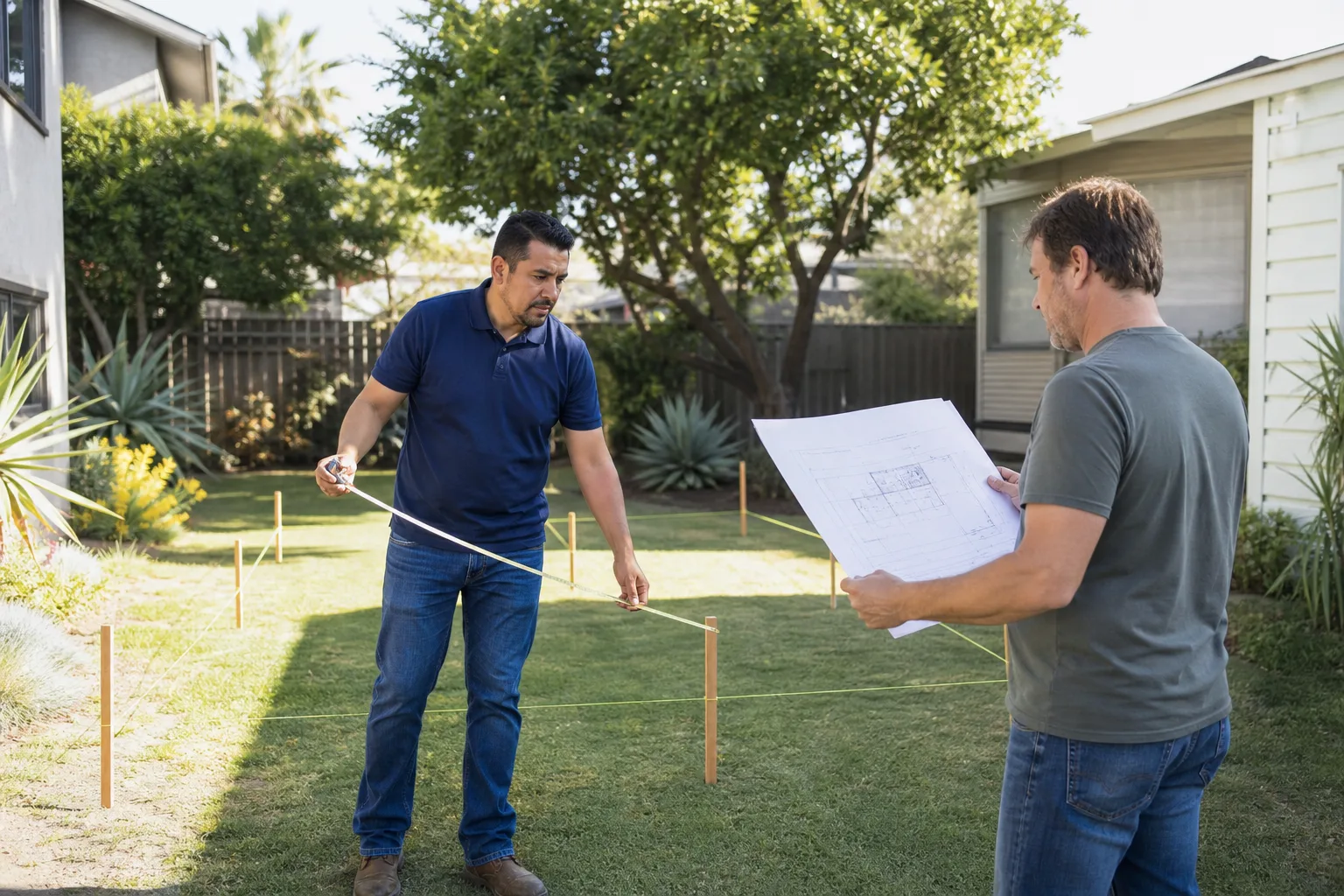
- They measure. A lot. An accurate room addition bid in Las Vegas requires the contractor to measure existing walls, check ceiling height, look at the electrical panel, inspect the roofline, and evaluate tie-in conditions. A contractor who stands in the doorway with a tablet for ten minutes isn’t producing an accurate bid.
- They ask about your lot and setback. Setback variance (the city’s written permission to build closer to the property line than the standard rule allows) is a real factor for additions and ADUs in Las Vegas. A contractor who never brings it up may not have done many additions here.
- They explain what they cannot know yet. Hidden conditions exist in every remodel. A solid contractor names the likely ones (old stucco, cracked slab, undersized wiring) and explains how those items get priced when they surface.
- They arrive on time, in a marked vehicle, and with credentials. The look of the visit should be professional, and the person on your property should be background-checked. Our crews are background-checked and uniformed on every project, and that standard should be table stakes.
- They put a number on paper. A verbal price is not an estimate. A written, itemized bid handed to you before work starts is the only thing worth comparing against another bidder.
If your project is a prefab backyard unit rather than a stick-built addition, the estimate visit looks different. Ask which platform the contractor is fluent in. Abodu, Cover, Dvele, and Mighty Buildings all handle design, permitting, and delivery differently, and a builder who knows the actual platforms can tell you which one fits your lot. A builder who has never worked with them may say yes anyway.
Schedule, Payment, and Cleanup Habits That Predict the Finish
By the time the contract is signed, you’ve already seen the contractor’s habits. The trick is catching the ones that matter and treating them as predictive rather than incidental.
Schedule communication. A contractor who texts or calls to update you before you ask, even when nothing’s changed, is telling you the project’s communication will be steady. A contractor who goes quiet between milestones will eventually go quiet during the biggest delay of the job.
Payment discipline. Payments divided across clear milestones (demo complete, slab poured, framing passed, drywall installed, final walkthrough) keep leverage with you. Payments stacked early (deposit plus framing paid before inspection) remove your leverage when the work slows.
Cleanup habits. Walk around the site during the estimate. If the contractor’s truck is a mess, the site will be a mess. If they leave the appointment without offering to walk the yard or asking how you’ll access the site, expect the same casual approach when the dumpster needs moving. Jobs that finish clean are managed by people who care about the finish state from day one.
Callbacks. Ask how the contractor handles a callback after the project closes. Their answer tells you what your one-year guarantee is worth in practice. The Garrison Code is our short version: show up in the window, price in writing, by the book, leave it clean, stand behind it for a year. Ask your other bidders what their version is.
Common Mistakes to Avoid
These are the missteps we see most often in Las Vegas, typically after the fact, when a homeowner is trying to untangle a problem.
- Comparing bids by the bottom line only. The lowest number is frequently missing scope items (electrical, HVAC, roof tie-in). Line the bids up side by side before comparing, because a $20,000 gap often turns out to be $30,000 of unfinished work.
- Letting a contractor talk you out of a permit. It’s the highest-risk shortcut in the trade. You carry the legal and resale consequences, not the contractor, and the contractor knows it.
- Skipping the NSCB license check. It takes ten minutes and includes disciplinary actions most homeowners never read. A contractor who avoids your question about it has already answered.
- Signing a lump-sum contract with vague change-order language. In Clark County’s permitting environment, changes do happen. The contract needs to say how they get priced before any work is done on them.
- Choosing a builder with no Las Vegas references. Building an addition in Las Vegas involves specific things (slab construction, roof tie-ins to existing tile, HVAC ducting in tight attics) that out-of-market contractors won’t know.
- Paying the deposit in cash with no written receipt. A written price and a written payment schedule are the baseline. If a contractor resists putting a payment in writing, walk away.
- Assuming the schedule will fix itself. A project that starts two weeks late with no explanation will usually finish late too. Address the first slippage early, in writing.
When to Call a Professional
Some decisions shouldn’t wait for more research. If a contractor has already pushed you toward an unpermitted job, refused to itemize the bid, or handed over a contract with “time is not of the essence” language, it’s worth getting a second opinion from a builder who can price the job honestly before you commit. The same goes if you suspect an existing addition on a home you’re buying was built without permits, or if you’re comparing two bids that don’t line up line by line. In those cases, a fresh estimate is your fastest way to see what a real bid should look like.
Fielding ADU Builders Las Vegas offers free estimates in Las Vegas. We schedule the visit, hand you a written itemized bid before work starts, pull permits the right way, and back every addition with The Garrison Standard. Call (888) 418-2161 to schedule your free estimate. Our team answers live, and we’re happy to walk through a competing bid line by line.
Frequently Asked Questions

Start with the Nevada State Contractors Board license record, confirm status is active and the classification covers residential additions, and verify the monetary limit is at or above your project budget. Then ask for an itemized written bid, a written payment schedule, and a written warranty on workmanship. A legitimate contractor will provide all three without hesitation and won’t discourage a permit.
Yes. Room additions in Las Vegas require a building permit, either through Clark County or the city depending on the property’s jurisdiction, plus permits for electrical, plumbing, and mechanical work. Construction cannot legally break ground without them. A contractor who suggests skipping the permit is breaking the rules and handing you the liability.
Room additions in Las Vegas typically run roughly $250 to $400 per square foot before permit fees and finish upgrades, so a 400-square-foot addition often lands in the $100,000 to $160,000 range. Costs rise with roof tie-in complexity, foundation work, and finish level. Always compare itemized bids, since a smaller lump sum usually reflects missing scope. Call (888) 418-2161 for an exact quote on your project, because estimates are free.
With a fixed-price written bid that names every line, the number you approve on day one should be the number on the final invoice. Changes you request (a different window package, extra electrical) are separate and signed off before the work is done. Hidden conditions in the existing structure, when they surface, get priced under whatever change-order terms the contract spells out before any work proceeds.
A straight room addition in the Las Vegas area typically runs three to five months of construction once permits clear, depending on size, roof tie-in, and finish level. The permitting phase adds its own time on the front end, at Clark County or the city. Any contractor promising a full addition in a matter of weeks without permits should be asked to explain exactly how that’s possible.
Do not sign anything, and get a second bid. There are only a few reasons a contractor pushes back on permits: they can’t legally pull one, their drawings won’t pass review, or they want to avoid inspections. None of those are in your interest. A legitimate builder will pull the permit and include the fees in the line-item budget, which is what we do on every room addition we build.
The Bottom Line
The dangerous room addition warning signs are the quiet ones: a nudge to skip permits, a refusal to itemize, a contract that protects the builder from schedule consequences, and a calendar that’s wide open in a busy Las Vegas market. Those signals show up during the estimate and contract phase, months before a problem becomes visible on the job. Check the Nevada State Contractors Board record line by line, insist on a written itemized bid, ask what happens when the schedule slips, and compare every bidder against the same standard. The right contractor puts the price in writing, pulls the permit by the book, and stands behind the work for a year in writing. When you’re ready to see that in practice, call (888) 418-2161 for a free estimate.
Written by the team at Fielding ADU Builders Las Vegas.