Last updated November 18, 2026
Room Addition Contractor Troubleshooting: Common Problems and How to Fix Them
If you have spent any time around construction complaints, you would expect the worst stories to involve a contractor who took a deposit and disappeared. That is not the most common one. More often, the phone call comes from someone who hired a licensed company, paid the full price, watched the crew clean up and drive away, and then watched the work fail a year and a half later. The cracks show up at the seam where the new room meets the old house. The new bedroom runs eight degrees hotter than the rest of the house. A window drips in July and nobody can say why. Here is what we have learned building and troubleshooting room additions, and how to figure out whether your problem is cosmetic, structural, or something the original contractor owes you.
Quick Answer
Most room addition problems after construction come from one of four pre-build decisions: how the new structure was tied to the existing house, how the HVAC ducts were designed, how water was flashed out of the wall and roof junctions, and whether inspections were actually passed. Cracks at the junction, hot rooms, and interior water stains are symptoms, not the failure itself. Identifying which of the four decisions went wrong tells you whether you can fix it yourself, need a repair visit, or have grounds for a warranty claim or a complaint with the Nevada State Contractors Board.
Table of Contents
- Is that crack at the old-to-new wall cosmetic or structural?
- Why your new addition is always too hot or too cold
- What flashing failure looks like from inside the house
- How to document defects for a warranty claim in Nevada
- Can you fix it yourself without voiding the guarantee?
- Permits, inspections, and the paper trail that protects you
- How Las Vegas climate stress-test your addition
- Common mistakes to avoid
Is That Crack at the Old-to-New Wall Cosmetic or Structural?
Every addition moves a little. The new footing settles, the old house does not move the same way, and Las Vegas soil – a mix of caliche hardpan and expansive clay in places – makes that movement more pronounced than it would be in most parts of the country. The question is not whether you will see a crack. It is whether the crack is telling you something the contractor needs to answer for.
Cosmetic settlement cracks are almost always hairline (under 1/8 inch), run diagonally or vertically, and appear within the first year as the new structure finds its footing. They stop growing once the ground stabilizes. They are common, expected, and not a call for alarm.
A structural connection failure looks different. Watch for these signs:
- Cracks wider than 1/8 inch at the junction, especially if they widen over a few months.
- Cracks that run horizontally across the drywall, which often signals shear movement rather than settlement.
- Separating trim or gaps at the ceiling line where the new ceiling meets the old wall.
- Doors that suddenly stick in the new room but not the old, or vice versa.
- Visible separation at the exterior where siding meets the old wall – you should not be able to slide a coin in.
A structural crack points to one of two things: the new footing was undersized for the soil, or the connection between the new wall and the old house was done with the wrong hardware or skipped the tie-in details. Both are pre-build problems that should have been caught in the plans. If you are evaluating a contractor before the work starts, the quality of the tie-in and footing plan is the first thing to ask about. Our room addition contractor in Las Vegas page goes through what a proper connection plan looks like.
Why Your New Addition Is Always Too Hot or Too Cold
This is the problem homeowners most often misdiagnose. The new room runs hot in summer, cool in winter, and the first instinct is to blame the AC unit. So they call an HVAC company, who looks at the equipment, sees it is sized correctly for the whole house, and shrugs. The real problem is almost always duct design: the single small supply duct that was run to the addition was sized for the square footage on paper but not for the length of the run, the number of turns, or the pressure drop across a 20-foot duct.
Here is the test. On a 105-degree Las Vegas afternoon, close the new room door and leave it for one hour. Then open it and compare the temperature to the hall. More than five degrees of difference, and you have a duct problem, not an equipment problem. Call your HVAC contractor and ask specifically for a Manual D calculation – that is the industry standard for duct sizing, and a competent contractor will have one for the addition.
A proper fix usually looks like one of three things:
- Add a return-air duct in the addition. Most single-room additions get supply air but no return, which pressurizes the room and keeps air from circulating.
- Resize the supply duct to match the calculated load, not just the square footage.
- Add a dedicated mini-split for the room, which is often cheaper than reworking the duct system in an older house.
This is a pre-build decision. If the contractor who built your addition promised it would be comfortable and it is not, the question to ask is whether a load calculation was done. Contractors who do not run one tend to rely on rules of thumb that were fine in 1995 and are not fine in Las Vegas today.
What Flashing Failure Looks Like From Inside the House
Flashing is the metal (and sometimes membrane) that directs water away from the joints where the addition meets the existing roof, the existing wall, or a new window. It is hidden under siding and roofing, invisible on a walkthrough, and the single most common cause of water intrusion in a room addition. Las Vegas averages fewer than five inches of rain a year, but the storms that do come are short and violent. A monsoon cell can drop an inch in 30 minutes, and bad flashing that would have leaked in Seattle never leaks here – until it does, and then it leaks inside a wall cavity.
What it looks like from inside the house, in the order it usually shows up:
- A faint brownish stain on the ceiling or upper wall, often near a corner, that darkens after a storm.
- Paint bubbling or peeling in a horizontal line, which traces the path water is taking behind the drywall.
- Musty smell in a closet or cabinet against an exterior wall, with no visible water – this is often water that got behind the wall and never dried.
- Efflorescence – a white chalky residue – on drywall or baseboards, which is mineral salt left behind as water evaporates.
By the time you see any of these, water has been getting in for a while. The fix is not a patch on the inside wall; it is pulling the exterior siding or roofing to inspect and correct the flashing. That is a flashing and waterproofing repair, not a drywall repair, and it needs to be done from the outside in. Left alone, interior water damage in Las Vegas runs from a few hundred dollars for drywall and paint to several thousand once framing or insulation is wet and mold has to be remediated.
How to Document Defects for a Warranty Claim in Nevada
Nevada has a specific process for construction defect claims, and the paper trail matters more than the severity of the defect. If you end up needing to make a claim under a warranty, or file a complaint with the Nevada State Contractors Board (the state agency that licenses and disciplines contractors in Nevada), documentation is what carries the case. Here is how to build that file.
- Photograph the defect with scale. Put a tape measure or a coin next to the crack and take the photo at the same distance each time, every two weeks. Date the photo file or include a dated note in frame.
- Log the weather. If it is a flashing or water problem, note the storm date and amount. Las Vegas weather records are public and the board will check.
- Get a written diagnosis from a second contractor. Not an estimate to fix – a written opinion on what failed and why. Many contractors will provide this for a nominal fee, and it is the single strongest piece of documentation.
- Send the contractor a written notice of the defect by certified mail. Nevada law generally requires written notice and an opportunity to respond before you escalate. Keep the receipt.
- Keep every receipt for temporary repairs, alternate housing, or damage mitigation. Those are recoverable in many cases.
- Take photos of the final condition before any repair is made. If you patch the crack and then file a claim, you have no evidence of the failure.
If the contractor is licensed and the defect is covered, most will come back and fix it. If they will not, the Contractors Board complaint process is the next step. The written price, the contract, the photos, and the second-opinion letter are the whole case.
Can You Fix It Yourself Without Voiding the Guarantee?
The answer depends on what you are touching. Paint, drywall patching, trim rework, and caulking are cosmetic, and touching them will not void a workmanship guarantee on the structural, mechanical, or waterproofing work. If you are comfortable with a putty knife and a paintbrush, those fixes are fine and usually cheaper than a service call.
But anything on this list will void the guarantee, and on some jobs it also creates a liability problem if the failure later causes damage:
- Reframing or sistering a cracked structural member, even if the crack looks cosmetic.
- Cutting into or rerouting the HVAC ductwork to fix the temperature problem.
- Removing or replacing flashing or roof shingles at an addition joint.
- Patching a foundation crack without diagnosing the cause first.
- Changing the exterior siding at the junction, which is often where the flashing lives.
Before you touch any of those, read the guarantee. A legitimate workmanship guarantee will specify exactly what is covered, how long, and what voids it. If your contractor’s paperwork does not spell that out, ask for it in writing. The Garrison Standard – the operating code behind Fielding ADU Builders and the wider Garrison Partners family – covers workmanship defects for 365 days and returns at no charge if something fails. That is the kind of language you want to see in your guarantee, on paper, with the coverage spelled out.
For a garage conversion, the line gets blurrier because the garage is already attached and the work is inside the existing envelope. Our garage conversion contractor in Las Vegas page covers what is and is not a warranty item on that build type.
Permits, Inspections, and the Paper Trail That Protects You
Every room addition in Las Vegas needs a permit from Clark County – or the City of Las Vegas, Henderson, or North Las Vegas, depending on your address. The permit file is your best insurance policy against problems after construction, because every inspection that was signed off documents that a specific piece of work met code at the time it was done. If your addition has no permit file, you have no record any of the four pre-build decisions were made correctly.
Here is what to check, in order:
- Pull the permit record online. Every local jurisdiction in Las Vegas Valley has a permit search tool. Enter your address and confirm a permit was issued for the addition, with the square footage and scope matching what was built.
- Check each inspection was passed, not just scheduled. A final inspection sign-off is the one that matters, but you want framing, rough mechanical, rough electrical, and rough plumbing all signed off too.
- Confirm the contractor’s license. Nevada license records are public. The name on the permit should match a licensed contractor.
- Ask for the as-built drawings. If the addition was built to a variance, the written approval is part of the file and worth having.
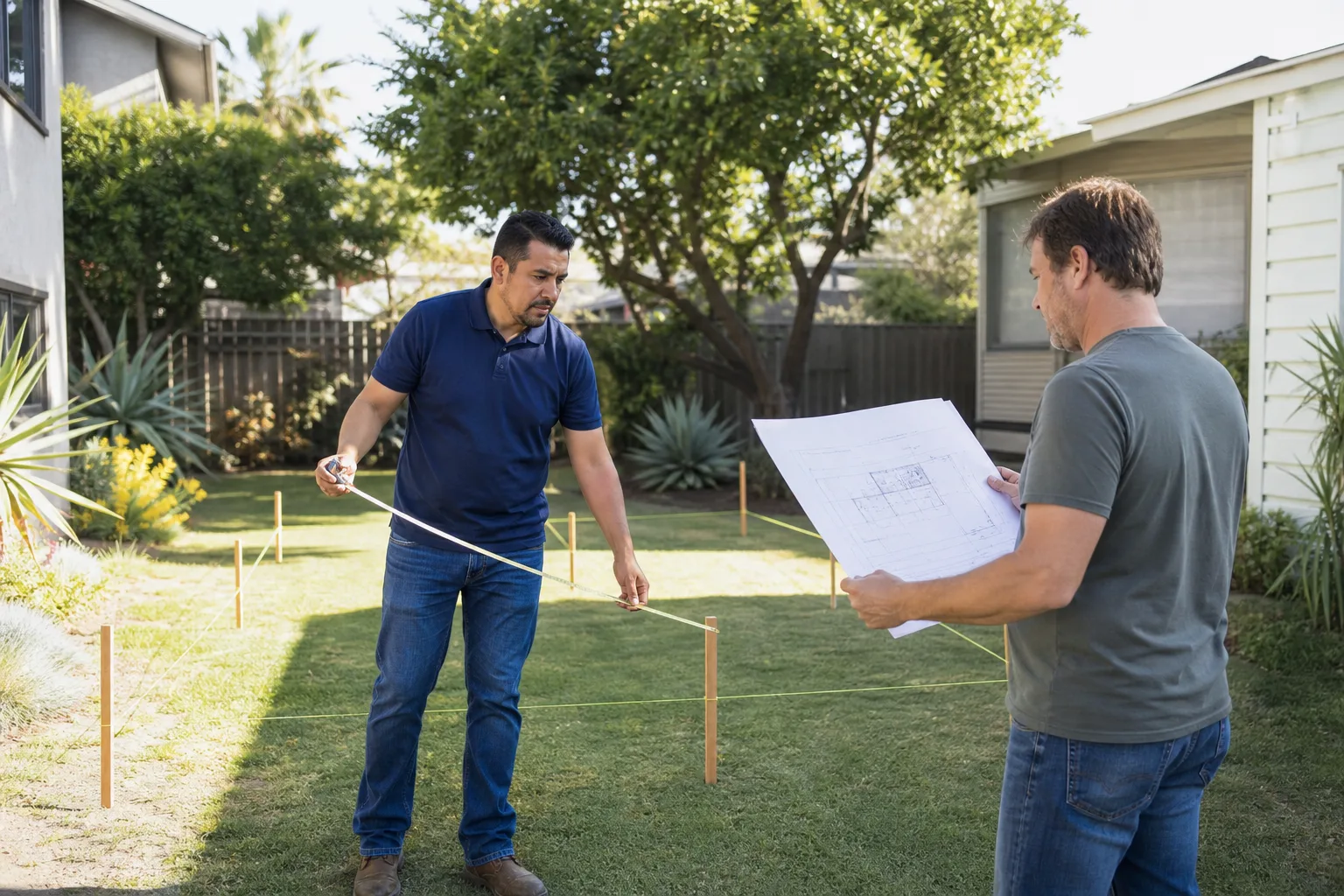
If you are planning a project now and want to avoid ever needing this guide, this is the part to take seriously before the first nail goes in. Fielding ADU Builders puts the price in writing before any work starts, pulls every permit, and holds the crew to The Garrison Code – show up in the window, price in writing, by the book, leave it clean, stand behind it for a year. That code is what makes the difference between an addition that holds and one that cracks.
Las Vegas has specific code wrinkles that out-of-state contractors miss. Roof assemblies have to handle the low-rain, high-heat cycle, exterior walls in new additions need to meet current energy code for Clark County, and the site plan has to account for setback and drainage in an environment where the soil does not absorb water the way a contractor from a wetter climate expects. Our ADU builders in Las Vegas page walks through how we approach those as a starting point for a project before construction begins.
How Las Vegas Climate Stress-Tests Your Addition
Room additions in Las Vegas fail differently than additions in milder climates. The same build that is fine in Phoenix can fail within 18 months here if the contractor built to a generic spec. Three specific stresses matter.
Heat and thermal movement. Exterior wall surfaces on a south- or west-facing addition can hit 150 degrees in July. Materials expand and contract a lot between a 70-degree winter morning and a 115-degree summer afternoon. Joints that were caulked but not flashed or that were sealed without a proper movement joint will crack at the old-to-new junction. A proper build leaves a designed control joint where the addition meets the old house so the movement happens where it should, not at the drywall.
Soil movement. Las Vegas Valley soil ranges from caliche hardpan to expansive clay. The right footing depth and drainage depends on the site. A footing that is undersized for the site will crack the slab or shift the wall, and the symptom shows up as that interior crack you thought was cosmetic. Before your project kicks off, ask how the footing was specified and whether the contractor saw the soil report.
Monsoon water. Fewer than five inches of rain a year, but the rain that comes lands fast. Flashing that would never fail in a climate with steady, gentle rain fails here when 0.8 inches falls in one hour and pools on a flat section of roof. A Las Vegas addition needs the same flashing and drainage spec as a wetter climate – more, actually, because there is less margin for temporary ponding.
This is why we generally steer homeowners toward build methods and materials that are proven in Southern Nevada. Prefab and modular platforms – Cover, Dvele, Mighty Buildings, Boxabl – are built in controlled environments and shipped to site with the assembly details already engineered. Conventional builds using James Hardie siding and a properly specified enclosure are also reliable, but the detailing has to be done correctly. If you are weighing methods, our Las Vegas home page lists where to start. The broader lesson is the same in every case: match the build method to the site, the soil, and the budget before you sign.
Common Mistakes to Avoid
- Skipping the load calculation to save a few hundred dollars. An HVAC load calc is cheap and prevents the most common addition problem. Skipping it costs thousands to correct later.
- Accepting a verbal price and a handshake. Las Vegas has no shortage of contractors who will deliver a verbal estimate and then find “extras” once the foundation is poured. Get the price in writing before any work starts, and hold it there.
- Signing before the permit is issued. If your contractor starts the foundation before the permit is pulled, you have no inspection record for anything that matters.
- Doing your own repairs before calling the original contractor. Cosmetic patching is fine, but anything structural or waterproofing voids a workmanship guarantee and makes the warranty claim harder to prove.
- Assuming a hairline crack is normal without watching it. A hairline crack that grows over two months is not normal settlement. Photograph it every two weeks and get it looked at.
- Hiring a contractor based on a low bid and no license check. Nevada license records are public and take 60 seconds. A contractor without a license in Nevada is a problem waiting to happen and probably cannot legally file for a permit.
- Not reading the flashing plan before construction. Flashing is invisible after the siding goes up. If you want one question answered before the job starts, make it the flashing and how water will drain at the junction.
When to Call a Professional
Call a professional if any of these apply: a crack at the junction is wider than 1/8 inch, or you can see separation at the exterior; a ceiling or upper-wall stain appears after rain; the new room runs more than five degrees different from the rest of the house and HVAC service has not resolved it; you are seeing doors stick or trim separate; or a permit search turns up no record of the addition. Any of those is a call now, not next month. If you are within the warranty period and the defect is a workmanship issue, a written notice to your contractor is the first step. Fielding ADU Builders Las Vegas offers free estimates in Las Vegas – call (888) 418-2161 and we will come out, look at the problem, and tell you in writing what we think is wrong and what it takes to fix it. Every technician who comes out is background-checked, arrives in uniform, and 20 years of experience means they have seen your specific failure mode before.
Frequently Asked Questions
No – a hairline crack under 1/8 inch that stops growing over the first year is cosmetic settlement and does not need more than a paint touch-up. A crack wider than 1/8 inch, a crack that runs horizontally, or any crack that widens over two months points to a structural connection issue and needs a written diagnosis. Call (888) 418-2161 for a free estimate on a diagnostic visit.
Almost always a duct design error, not an equipment problem. If the addition has supply air but no return, or the supply duct was sized from square footage rather than the full Manual D calculation, the room will not stay comfortable. Ask your HVAC contractor whether a load calculation was done for the addition. Call (888) 418-2161 for a free estimate if you want a second opinion on the fix.
It depends on your contract and the type of defect, but Nevada law sets limits that are measured in years, not days – waiting is not your friend. The practical rule: notify your contractor in writing by certified mail as soon as you have evidence of a covered defect, and keep every photo you have taken. A warranty claim with strong documentation is far easier to win than one with a single blurry photo taken months later.
It should not. The number you approve at the start should be the number on the final invoice. We put the price in writing before any work starts – no change orders, no door-price surprises. Call (888) 418-2161 for an exact quote on your repair – estimates are free.
That is a serious problem and possibly a contractor board complaint. No permit means no inspection record, and in Las Vegas it means resale disclosures will flag the work, which can cost you at sale. You will need to work with a licensed contractor and the local jurisdiction to get the work brought into compliance. Call (888) 418-2161 for a free estimate on what that looks like for your property.
Every job that needs one. Some repairs – cosmetic patching, drywall, paint – do not require a permit. Structural repairs, flashing replacement over a certain size, HVAC duct rework, and any work affecting the envelope do. We tell you upfront which category your repair falls into. Call (888) 418-2161 for a free estimate.
The Bottom Line
Most room addition problems you are dealing with today were locked in before a single nail went in. Cracks at the junction point to tie-in and footing decisions. Hot rooms point to duct design. Water stains point to flashing. Missing permits point to a contractor who cut a corner you probably did not know existed. Diagnosing the problem is the first step. The second is deciding whether to fix it yourself, file a warranty claim, or call someone who can tell you in writing what is wrong and what it costs. The Garrison Standard – price in writing, by the book, leave it clean, stand behind it for 365 days – is the anchor for every project we take on, whether it is a full addition, a room addition repair, or a garage conversion. If your project is still in front of you, start with a conversation before the first nail. If it is behind you, start with a call.
Get a Free Estimate in Las Vegas
If you are troubleshooting a problem with a room addition, or planning one for the first time and want to avoid needing this guide later, call Fielding ADU Builders Las Vegas at (888) 418-2161. You will reach a live person, 24 hours a day, 7 days a week – no voicemail, no callback queue. We will come out, look at the work, and put the price in writing before anything starts. No-hassle upfront pricing, background-checked uniformed technicians on every job, permits pulled and inspections passed, and a full year of written guarantee that if the work fails, we come back and make it right at no charge.
Written by the team at Fielding ADU Builders Las Vegas.