Last updated November 18, 2026
DIY vs Professional ADU: The Las Vegas Homeowner’s Decision Guide
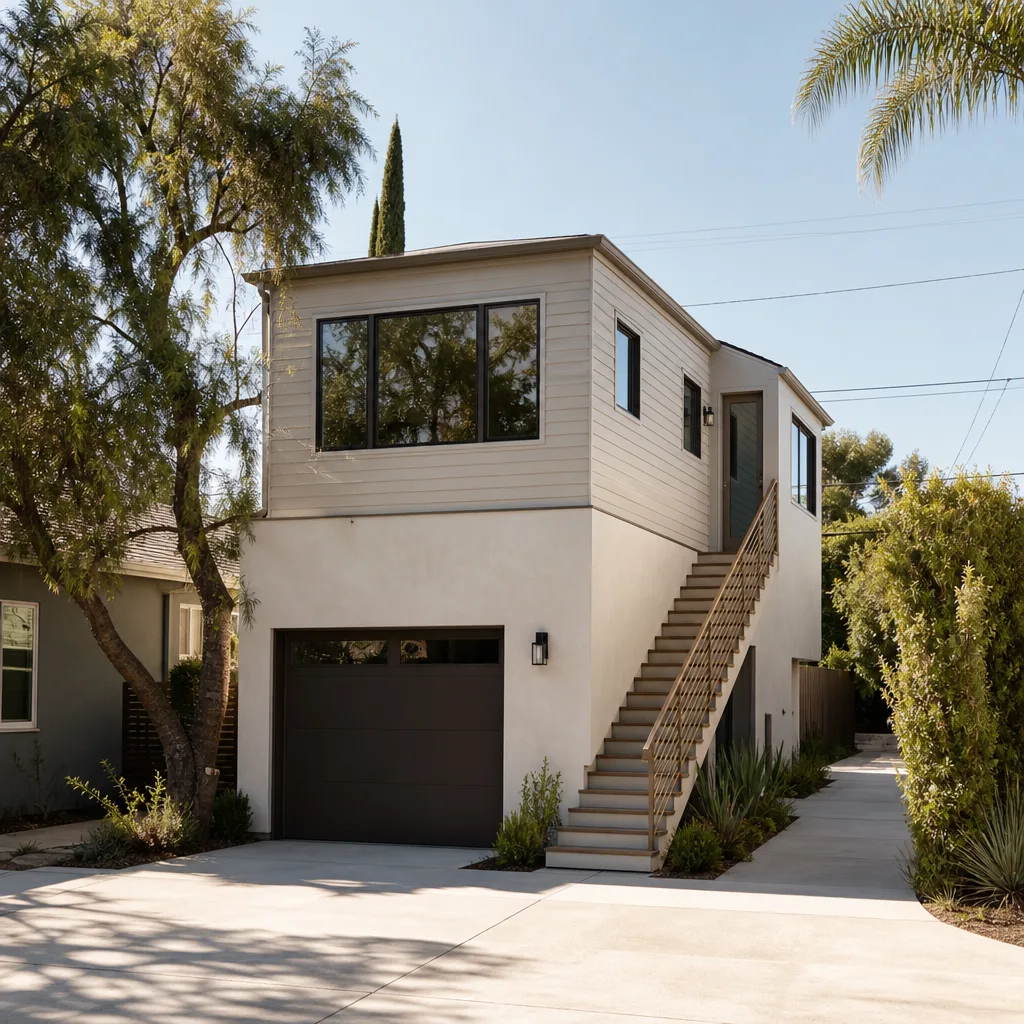
Here’s the counterintuitive part: the DIY versus professional ADU question in Las Vegas isn’t really a skill question. It’s a permit-authority question. Nevada’s owner-builder exemption lets a homeowner pull permits and self-perform some work, and that exemption looks like a fast track to saving $40,000. Then the project hits a re-inspection, or you try to refi in three years, and the savings start disappearing. In our experience, the homeowners who call us after a stalled owner-build rarely lost the argument on craftsmanship. They lost it on documentation. This guide walks through what you can legally self-perform, what DIY actually costs once you add up everything, and where a professional bid stops being optional.
Quick Answer
For most Las Vegas homeowners, a professionally built ADU is the right call when the project includes a foundation, a new electrical service, or a roof, because those systems require licensed trades and permitted inspections that an owner-builder cannot legally skip and lenders will scrutinize. DIY is a legitimate, money-saving choice only for finish work after permits are closed – painting, landscaping, and fixture swaps. The middle ground (self-performing the structure) almost always costs more than it saves.
Table of Contents
- What Nevada’s Owner-Builder Permit Actually Allows
- What DIY Really Costs in Las Vegas
- The Trades You Can’t Self-Perform, No Matter What
- Three ADU Tasks Where DIY Genuinely Makes Sense in Las Vegas
- The Resale and Rental Income Problem
- How Las Vegas Heat and Soil Change the DIY Math
- The Plain Decision Framework
- Where Prefab and Modular Fit In
What Nevada’s Owner-Builder Permit Actually Allows
Nevada lets a homeowner act as their own general contractor under an owner-builder exemption, but the exemption is narrower than most people assume. You can pull the permit in your own name for a home you’ll occupy. You can perform some of the work yourself. But the moment a task requires a licensed trade, you’re the one hiring and managing that licensed subcontractor, and you’re the one on the hook if their work fails inspection. The state doesn’t care that you’re saving money. It cares that the work was done by someone legally allowed to do it.
Here’s what the owner-builder route realistically demands of you:
- A general contractor’s role without a GC license. You schedule inspections, coordinate subs, and manage the site. The permit is in your name, so the compliance is on you.
- Documentation you must keep. Copies of every sub’s license number, contracts, lien waivers, inspection cards, and final signed-off permits. Lenders and title companies will ask for these later.
- Disclosure at resale. In Nevada, an owner-built home is a material fact. You’ll disclose it, and a buyer’s lender will read the permit history.
- No warranty backstop. If the sub you hired for framing walks away mid-project, you don’t have a general contractor’s guarantee to fall back on. You have a contract dispute.
The exemption exists for genuine owner-occupants doing their own work, not for a homeowner who wants to sub out a $250,000 ADU. That’s the misconception that sinks most of the projects we’ve been called in to rescue in Las Vegas. The permit was legal. The execution wasn’t there.
What DIY Really Costs in Las Vegas
The DIY pitch is almost always framed as “labor savings,” which ignores four real costs that show up on every owner-built ADU in Clark County. We’ve walked through enough of these budgets to know the honest number is closer to the professional bid than homeowners expect.
Here’s a realistic line-by-line comparison for a 600-square-foot detached ADU in Las Vegas:
- Permit fees (identical for either path): $6,000-$11,000 in Clark County depending on size and utility tie-ins.
- Material markup you lose: 15-25% higher on lumber, concrete, windows, and fixtures, because you don’t get contractor pricing. On a $140,000 material bill, that’s $21,000-$35,000 gone before you lift a hammer.
- Re-inspection fees: $75-$300 per failed inspection, plus the schedule delay that pushes your finish date out weeks at a time.
- Your time at real market value: A GC spends 200-400 hours on an ADU. If your time is worth $50 an hour, that’s $10,000-$20,000 in unpaid labor you’re donating.
- Change orders from subs who price owner-builders higher: Contractors charge non-repeat customers a premium because there’s no relationship to protect. Expect a 5-10% bump on every sub bid.
When you add it up honestly, the “savings” on a $250,000 Las Vegas ADU often lands somewhere between $10,000 and $25,000, before the first failed inspection. The price you get in writing from a builder covers all of it. There’s no mystery line item and no surprise when the drywall comes down. That’s the difference between a bid and a guess.
The Trades You Can’t Self-Perform, No Matter What
This is the part of the owner-builder conversation that gets glossed over, and it’s the part that matters. Some work requires a licensed subcontractor in Nevada regardless of your exemption. Trying to self-perform these will fail inspection, and in some cases the state will require the work to be ripped out and redone before the permit can close.
The trades that require a licensed sub every time in Las Vegas:
- Electrical service and panel work. A new 200-amp service or panel upgrade requires a licensed electrician. ADUs almost always need a new service.
- Gas line extensions. Any gas appliance connection in the ADU requires a licensed plumber or gas fitter.
- Plumbing rough-in. Supply and drain lines under the permit require a licensed plumber.
- Structural framing on the permitted footprint. The engineering is typically stamped, and the framing must be installed by someone with the license to carry it.
- HVAC installation and refrigerant work. Licensed mechanical contractor, no exceptions.
What’s left that you might legally self-perform? Finish work after rough-in inspections are signed off, and limited site prep. That’s the honest boundary. When a homeowner tells us they plan to “self-perform the build” in Las Vegas, what they’re actually saying is they’ll act as an unlicensed GC and hire five licensed trades. That’s legal. It’s also not a meaningful savings once you count the coordination time. If you want to see how the professional side breaks down, our ADU Builders in Las Vegas page walks through the process end to end.
Three ADU Tasks Where DIY Genuinely Makes Sense in Las Vegas
We mean this sincerely: there are real places where DIY pays off, and we encourage homeowners to take them. Doing these yourself doesn’t jeopardize the permit or the resale because they happen after the inspector has signed off. This is the way to save $8,000-$15,000 on a Las Vegas ADU without touching the documentation risk.
- Finish painting. Interior and exterior paint on a finished ADU runs $4,000-$9,000 professionally. Do it yourself in a weekend and the finish work is yours. Pick a light-reflective exterior color for Las Vegas heat – it genuinely improves cooling.
- Landscaping restoration. After the build, the yard needs re-leveling, topsoil, gravel, or drought-tolerant planting. This is $2,000-$6,000 in professional labor and requires no permit. Las Vegas Water Authority rebates for turf removal don’t apply to the ADU footprint, but they do apply to the surrounding landscape in many cases – check before you design the yard.
- Fixture installation after rough-in sign-off. Faucets, showerheads, cabinet pulls, pendant lights, and appliance hookups. This is the last 5% of the build and the easiest to do yourself. Once the electrical and plumbing rough-ins are signed, swapping the fixtures doesn’t reopen the permit.
Notice what’s not on this list: drywall hanging, tile setting, floor installation, or anything behind a wall. These are tempting, but they cost more in failed inspections and schedule delays than the labor savings. A drywall job that fails inspection because it covers a rough-in the inspector hasn’t yet seen will cost you more than the drywaller would have charged.
The Resale and Rental Income Problem
This is the part of the decision that has the biggest long-term financial consequence, and the part homeowners think about last. When you sell or refinance a Las Vegas home with an ADU, the lender and title company treat that ADU as a material asset. If it was built under an owner-builder permit, they’ll look harder at the paperwork. If the permit history is incomplete or the final inspection is unsigned, they may not count it at all.
Here’s what that means in practice:
- Rental income underwriting. Banks that will underwrite ADU rental income (which can add meaningfully to your appraisal in the Las Vegas rental market) require proof the ADU is a legal, permitted dwelling. Owner-built ADUs with shaky paper trails often get discounted or excluded.
- Appraisal risk. An appraiser who can’t verify the permit status of a detached ADU will typically value the structure at a fraction of build cost, sometimes as outbuilding space rather than living space.
- Buyer financing. A buyer’s conventional loan requires the ADU to be permitted. Owner-built ADUs with an open permit or an incomplete inspection history can kill a sale or force a cash-only buyer at a discount.
- Insurance. Homeowner policies often won’t cover an unpermitted structure. A permitted ADU is straightforward to insure. An owner-built one with documentation gaps is not.
Our Garage Conversion Contractor in Las Vegas page covers how permitted conversions clear the title and lender review that trips up so many owner-built projects. The money you saved building it yourself shrinks against the discount a future buyer will demand when they see the paperwork. In a Las Vegas market where ADU rental yields are aggressively underwritten, permitted status isn’t a technicality – it’s the whole value proposition.
How Las Vegas Heat and Soil Change the DIY Math
Las Vegas is not a forgiving climate for a first-time builder. Two things work against a DIY ADU here that wouldn’t matter in a milder market.
First, the soil. Much of the Las Vegas Valley – especially the west side and North Las Vegas – sits on caliche, a cement-like calcium carbonate layer that a shovel won’t dent. Foundation work that would be a quick trench-and-pour in most markets requires a jackhammer and commercial excavation equipment here. This isn’t a task anyone genuinely self-performs. It also isn’t a foundation type you want to improvise if you’ve never poured a slab.
Second, the heat. Summer construction between June and September costs more because crews work short shifts to avoid heat injury, and concrete pours, stucco, and paint all require specific temperature windows. A DIYer working through a July afternoon isn’t saving money – they’re working against the material specs. We’ve seen more Las Vegas ADU failures from improperly cured concrete and prematurely painted stucco in summer builds than from any other source.
Add the monsoon season (July through September) and you have a compressed build window that punishes a first-timer’s learning curve. This is where a builder with local experience is worth more than the bid sheet shows. Our Room Addition Contractor in Las Vegas team builds through this climate year-round for a reason.
The Plain Decision Framework
If you want the short version of this entire guide, here it is. Walk yourself through these three questions in order. Whichever trigger fires first tells you what to do.
- Does the project require a foundation? If yes, professional. Full stop. Las Vegas soil work is not a homeowner task.
- Does it require a new electrical service or panel upgrade? If yes, professional. Licensed electrician and inspection required, no exceptions.
- Does it require a new roof, or a change to the existing roof structure? If yes, professional. Roof penetrations and structural framing must be permitted and carried by licensed trades.
- Are all permits closed and rough-in inspections signed off? If yes, DIY becomes a legitimate choice for finish work. See the three tasks above.
Run this test honestly on your project plan. If any of the first three fires, the professional cost isn’t optional – it’s the only way the ADU closes out with a clean permit record. If only the fourth is true, do the finish work yourself and keep the savings.
Where Prefab and Modular Fit In
Prefab and modular ADUs sit in a useful middle space in the DIY versus professional conversation. Platforms like Dvele, Mighty Buildings, Boxabl, and Plant Prefab deliver a factory-built unit to your site, which reduces the amount of on-site craft labor that would otherwise be a homeowner decision. The installation, foundation, and utility connections still require professional work and permits, so the framework above still applies. But a prefab path can shave schedule and, in some cases, cost.
We work with all four platforms and can help you compare them against a conventional stick-built ADU on your specific lot. Boxabl is the smallest and fastest to place, Mighty Buildings and Plant Prefab sit in the mid-to-large market, and Dvele leans toward a higher finish level. Site prep, foundation, and utility tie-ins are typically 40-60% of the total cost even on the fastest prefab installations. Prefab doesn’t eliminate professional involvement – it changes where it happens.
The same principle applies to garage conversions, which is the cheapest permitted ADU path in Las Vegas because the shell and foundation already exist. If you’re converting a garage, our Fielding ADU Builders Las Vegas home page lists the conversion scope we run most often.
Common Mistakes to Avoid
- Pulling an owner-builder permit for a project you plan to sub out entirely. It’s legal in narrow cases, but it removes the licensed GC’s warranty backstop, and lenders notice at refi.
- Skipping the final inspection to save time. An unsigned final inspection can tank a future sale or refinance in Las Vegas. It’s the single most expensive “savings” in the guide.
- Underestimating caliche. A foundation quote that doesn’t mention caliche excavation on a Las Vegas lot is going to come back as a change order.
- Buying materials before checking contractor pricing. The 15-25% you lose on retail material markup usually wipes out the labor savings entirely.
- Assuming the ADU rental income will be underwritten. Banks require documented, permitted, professionally inspected space. Owner-built with paperwork gaps won’t count.
- Missing the HOA. Many Las Vegas master-planned communities – Summerlin, Green Valley, Southern Highlands – have ADU restrictions that require HOA approval before you even pull the permit.
- Starting in July. An August foundation pour on Las Vegas caliche is a schedule disaster waiting to happen. Plan the pour window around the heat.
When to Call a Professional
Call a professional if your ADU plan requires any foundation work, a new electrical service, gas or plumbing rough-in, or a structural roof change. Those are the four triggers, and in Las Vegas they cover roughly 90% of real ADU projects. Call us if you’ve already started an owner-build and hit an inspection failure you can’t clear, or if you’re unsure whether your permit is actually complete. We see those calls every month and we’re not squeamish about them. Fielding ADU Builders Las Vegas offers free estimates in Las Vegas – call (888) 418-2161. Every project gets a written price before any work starts, and The Garrison Standard covers workmanship for a full year in writing. If something fails inside that year, we come back and make it right at no charge.
Frequently Asked Questions
Yes, Nevada’s owner-builder exemption lets you pull permits on your own owner-occupied home, but you cannot self-perform licensed trades, and the permit documentation must be complete for the ADU to count as a legal dwelling at resale or refi. Most Las Vegas homeowners who start an owner-build end up hiring a professional to clear the inspections. Call (888) 418-2161 for a free estimate on the professional path.
A professionally built 600-square-foot detached ADU in Las Vegas typically runs $230,000-$320,000 turnkey, and a garage conversion runs $85,000-$160,000. DIY savings on the same project usually land between $10,000 and $25,000 once you count permit fees, lost contractor material pricing, re-inspection costs, and your time – far less than the headline “labor savings” number suggests. Call (888) 418-2161 for an exact quote – estimates are free.
Finish painting, landscaping restoration, and fixture installation after rough-in inspections are signed off. Those are the three tasks where DIY saves real money without touching the permit record. Everything behind a wall, plus electrical, plumbing, gas, HVAC, foundation, and roof work, requires licensed trades. Call (888) 418-2161 if you want to know which tasks on your specific plan fall on the DIY side.
It can, yes. Banks that underwrite ADU rental income require proof the unit is permitted and inspected, and appraisers will discount or exclude an ADU with documentation gaps. An owner-built ADU with an unsigned final inspection often gets valued as outbuilding space rather than living space. Call (888) 418-2161 to talk through whether your existing owner-built ADU can be brought into permit compliance.
Often yes, especially in Summerlin, Green Valley, and Southern Highlands, where architectural review boards have restrictions on setbacks, height, and unit visibility. Get HOA approval before pulling the permit, or you risk building something the association later forces you to modify. Call (888) 418-2161 if you’re unsure what your HOA requires.
A garage conversion typically takes 4-6 months; a detached stick-built ADU takes 7-10 months; a prefab installation from Dvele, Mighty Buildings, Boxabl, or Plant Prefab takes 4-7 months depending on site prep. Permit review alone runs 6-12 weeks in Clark County. A DIY build typically extends the schedule by 3-5 months. Call (888) 418-2161 to schedule your free estimate.
The Bottom Line
The DIY versus professional ADU decision in Las Vegas comes down to permit authority, not skill. If your project needs a foundation, a new electrical service, or a roof, the professional cost isn’t optional – it’s the only way the ADU closes out with the permit record a lender, appraiser, and future buyer will accept. If the permits are closed and you’re doing finish work, DIY is a genuine savings and we encourage it. Everything in between costs more than it saves. Our technicians have up to 20 years of experience running permitted ADUs in this climate and on this soil, and we put the price in writing before any work starts so the number you approve on day one is the number on the final invoice.
Ready to price the professional side of your Las Vegas ADU or garage conversion? Call Fielding ADU Builders Las Vegas at (888) 418-2161 for a free estimate. A live person answers, 24 hours a day, and every crew that comes to your property is background-checked and uniformed. We’ll walk your lot, run through the permit path, and hand you a written price before a single nail is driven.
Written by the team at Fielding ADU Builders Las Vegas.